Posted by: Michael | 07/31/2019
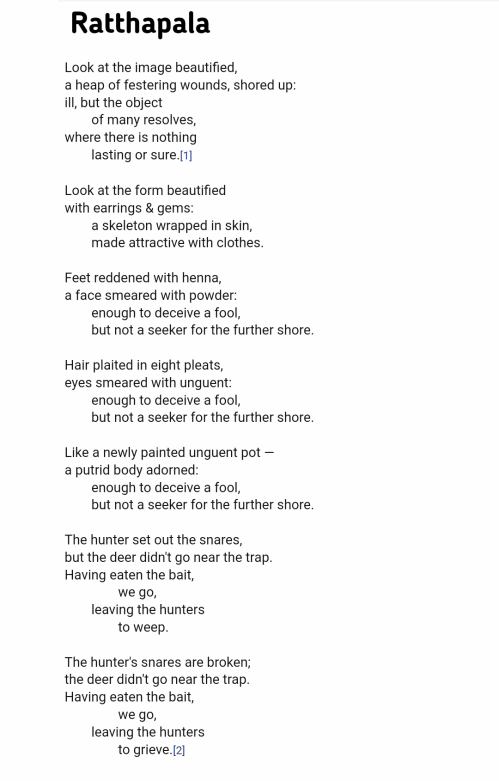
Ratthapala
Posted in Buddha, Buddha Vacana, Buddhism, Dhamma, Sangha, Theravada | Tags: disgust, patikulamanasikara, Theragatha
Posted by: Michael | 07/29/2019
Seeksorrow
I watch my mind complain about this and that and I’m astounded that I can be so assiduously dissatisfied in the midst of plenty and paradise. Is it the threat of future suffering and scarcity that leads me to discount the bounty of the present moment or is it that I’m afraid to accept (let alone embrace) the goodness of the present.
Clearly, there is a snare in every pleasure and it would be far better to become disenchanted by pain than intoxicated by desire. But, what about balance and equipoise? I have lived my life with a perception that has leaned a little too far into the shadow and it is a constant struggle to temper it with the light. Yet, if I were to follow my natural disposition to be a seeksorrow I would surely end up in the peta or hell-realm in short order.
Posted in Buddha, Buddhism, Cheerfulness, Dhamma, Theravada | Tags: negativity, perception, seeksorrow
Posted by: Michael | 07/27/2019
Right Giving
“When the Great Man (the Bodhisatta) gives an external object, he gives whatever is needed to whomever stands in need of it; and knowing by himself that someone is in need of something, he gives it even unasked, much more when asked. He gives sufficiently, not insufficiently, when there is something to be given. He does not give because he expects something in return. And when there is not enough to give sufficiently to all, he distributes evenly whatever can be shared. But he does not give things that issue in affliction for others, such as weapons, poisons, and intoxicants. Nor does he give amusements which are harmful and lead to negligence. And he does not give unsuitable food or drink to a person who is sick, even though he might ask for it, and he does not give what is suitable beyond the proper measure.”
Posted in Bodhisattvayana, Buddha, Buddhism, Dana, Dhamma, Parami, Theravada | Tags: Bodhisatta, perfection of giving
Posted by: Michael | 07/25/2019
Vacation Lust
Although I’m estranged from my wife, seeing her scantily clad body in these tropical settings is no easy thing. Luckily, this little device contains the sutta pita a in electronic form and I found the following verses in the Samyutta Nikaya by Ven. Vangisa begging the Ven. Ananda for help:
721 “I am burning with sensual lust, My mind is engulfed by fire. Please tell me how to extinguish it, Out of compassion, O Gotama.” 502 [The Venerable Ānanda:]
722 “It is through an inversion of perception That your mind is engulfed by fire. Turn away from the sign of beauty Provocative of sensual lust. 503
723 “See formations as alien, As suffering, not as self. Extinguish the great fire of lust; Don’t burn up again and again. 504
724 “Develop the mind on foulness, One-pointed, well concentrated; <406> Apply your mindfulness to the body, Be engrossed in revulsion. 505
Posted in Buddha, Buddha Vacana, Buddhism, Dhamma, Sensual Desire, Taṇhā, Theravada | Tags: desire, lust, Venerable Ananda, Venerable Vangisa
Posted by: Michael | 07/24/2019
Maranasati on the Way to Paradise
Right now I’m on the plane as we taxi on the runway waiting to take off. Over the years, my relationship to flying had evolved. When I was a young child I recall it being fun and novel. As I got older I developed a real fear of flying until the point that I actually chose to take busses instead of planes for a time during college.
Practicing the Dhamma has really helped me to get over the debilitating fear and, now with the help of Seneca and the Stoics, I’m at a place where the fear is outweighed by a desire to live, and die, well.
Death comes for us all. It is inescapable. Provided I live well by following the precepts, practicing the paramis and meditating as much as I can, what regrets will I have? If I die on this plane so be it and, in many ways, it would likely be an easier death than others which may await.
If I am to live long enough I may see one or all of my children die. If I live long enough I may find that the earth becomes uninhabital due to war, climate change or both. How much better a quick death faking fun the sky?
So, what is it that I really fear? Pain? Fear itself? Instead of allowing fear to take the reins, why not wrest control of my mind and body from its icy claws and be of use and service to myself and others? And, if I have really developed any bodhicitta, how can I aspire for bodhi while ceding to any fear; whether it be of death or hellfire?
Posted by: Michael | 07/22/2019
Encouragement
It’s particularly encouraging to see that it is becoming easier to whether the storms of invective as I continue to practice insult pacíficism. Although I still often feel the need to offer rebuttals to the negative characterizations of yours truly, it is easier to see that the best defense is silence.
But, why is that the case? In my current view, it seems that by not responding to the stream of insults every time it is unleashed, I’m showing both observers and the insulter that I don’t have to respond and that I’m more or less untouched by the criticism. It’s bittersweet comfort that my kids often come to secretly console me after my wife has tried to verbally back me to pieces.
And, yet, there’s still much work to be done. I’m getting better at keeping my mouth shut but I still have a long way to go in keeping my heart pure. I can, at least, see that the resentment and anger departs quickly and doesn’t linger so that’s good. To help myself along, I try to send forgiveness and metta to my wife as soon as possible after any disagreement.
A final thing that has struck me of late is simply that silence isn’t always the best response. If I truly take metta and karuna as my guides, there are times when it’s necessary to clarify my position and to make known what I will and won’t do. Doing this without resentment is hard but well worth the effort.
Life is short. Our time here is short. May we use the breath we have to do good, purify the mind and prevent the arising of evil.
Posted in Buddha, Buddhism, Daily Practice, Dhamma, Family Life, Forgiveness, Karuna, Metta, Theravada | Tags: compassion, death, loving-kindness, marriage, resentment
Posted by: Michael | 07/21/2019
Advice for the End of the World
When old age and death are advancing, what can I do but practice the teachings, practice morality, doing skillful and good actions?Adhivattamāne ca me, bhante, jarāmaraṇe kimassa karaṇīyaṃ aññatra dhammacariyāya samacariyāya kusalakiriyāya puññakiriyāyā”ti?
That’s so true, great king! That’s so true!Evametaṃ, mahārāja, evametaṃ, mahārāja.
When old age and death are advancing, what can you do but practice the teachings, practice morality, doing skillful and good actions?”
Adhivattamāne jarāmaraṇe kimassa karaṇīyaṃ aññatra dhammacariyāya samacariyāya kusalakiriyāya puññakiriyāyā”ti?
Whoever lives by the teaching
Yo dhammaṃ cari kāyena,in body, speech and mind,
vācāya uda cetasā;is praised in this life
Idheva naṃ pasaṃsanti,and departs to rejoice in heaven.
pecca sagge pamodatī”ti.
Posted in Buddha, Buddha Vacana, Buddhism, Dhamma, Theravada | Tags: apocalypse, Armageddon, end of the world Pasenadi
Posted by: Michael | 07/19/2019
The Rod
All
tremble at the rod,
all
are fearful of death.
Drawing the parallel to
yourself,
neither kill nor get others to kill.
All
tremble at the rod,
all
hold their life dear.
Drawing the parallel to
yourself,
neither kill nor get others to kill.
Whoever takes a rod
to harm living beings desiring ease,
when he himself is looking for ease,
will meet with no ease after death.
Whoever doesn’t take a rod
to harm living beings desiring ease,
when he himself is looking for ease,
will meet with ease after death.
Speak harshly to no one,
or the words will be thrown
right back at you.
Contentious talk is painful,
for you get struck by rods in return.
If, like a flattened metal pot
you don’t resound,
you’ve attained an Unbinding;
in you there’s found
no contention.
As a cowherd with a rod
drives cows to the field,
so aging & death
drive the life
of living beings.
When doing evil deeds,
the fool is oblivious.
The dullard
is tormented
by his own deeds,
as if burned by a fire.
Whoever, with a rod,
harasses an innocent man, unarmed,
quickly falls into any of ten things:
harsh pains, devastation, a broken body, grave illness,
mental derangement, trouble with the government,
violent slander, relatives lost, property dissolved,
houses burned down.
At the break-up of the body
this one with no discernment,
reappears in
hell.
Neither nakedness nor matted hair
nor mud nor the refusal of food
nor sleeping on the bare ground
nor dust & dirt nor squatting austerities
cleanses the mortal
who’s not gone beyond doubt.
If, though adorned, one lives in tune
with the chaste life
— calmed, tamed, & assured —
having put down the rod toward all beings,
he’s a contemplative
a brahman
a monk.
Who in the world
is a man constrained by conscience,
who awakens to censure
like a fine stallion to the whip?
Like a fine stallion
struck with a whip,
be ardent & chastened.
Through conviction
virtue, persistence,
concentration, judgment,
consummate in knowledge & conduct,
mindful,
you’ll abandon this not-insignificant pain.
Irrigators guide the water.
Fletchers shape the arrow shaft.
Carpenters shape the wood.
Those of good practices control
themselves.
Posted in Buddha, Buddha Vacana, Buddhism, Dhamma, Theravada | Tags: Dhammapada, nonharm, nonviolent
Posted by: Michael | 07/17/2019
Practicing Poverty
“Set aside a certain number of days, during which you shall be content with the scantiest and cheapest fare, with coarse and rough dress, saying to yourself the while: ‘Is this the condition that I feared?’” – Seneca
I’ve been finding so much inspiration in the Stoics lately and, here again, it’s another gem. It’s too bad that the ancient Stoics had no concept of kamma and were, instead, fatalists but that really only serves to point out the excellence of the Lord Buddha as a teacher of the Dhamma.
Practicing poverty will be somewhat different for me as it will entail refraining from buying anything outside of food and only using what I’ve bought to make meals. In other words, no eating out. Let’s try for a month and see how it goes.
Posted by: Michael | 07/16/2019
Cheating Myself – Asalha Puja
I’ve been cheating myself, making excuses no one will ever hear and that I’ll never remember. Why? Kamma. Laziness. Aversion. But, knowing that I will be heir to my actions whether I like it or not, why not take this special day to begin again?
I’ve not met my practice goals, my brahmacari goals nor my physical conditioning goals and do I feel better for it? No. Unsurprisingly, going easy on myself hasn’t results in more peace or calm. Going easy hasn’t resulted in more contentment.
And, yet, there needs to be balance. I can’t simply undertake these projects with a mind imbued with hate. The moment I see these goals as punishments is the moment they become harmful acts of self-mortification.
May I undertake these practices out of concern for my own happiness and wellbeing. May I undertake them for the benefit of many beings.
Happy Asalha Puja!
Posted in Aditthana, Buddha, Buddhism, Daily Practice, Dhamma, Theravada, Uposatha | Tags: asalha Puja, determination, goals, practice
Categories
- Abhaya-cariya
- Abyapajjo homi
- Aditthana
- Anatta
- Anicca
- Anigho homi
- asubha
- bhavana
- Bodhisattvayana
- brahmacariya
- Buddha
- Buddha Vacana
- Buddhism
- Cheerfulness
- Confession of Fault
- Daily Practice
- Dana
- Devata
- Dhamma
- Dream Yoga | Lucid Dreaming
- Dukkha
- Family Life
- Fasting
- Forgiveness
- Formal Meditation
- Gratitude
- Islam
- Karuna
- Khanti
- Kwan Se Um
- Lojong
- mahayana
- Maranasati
- Maranassati
- maranānussati
- martial arts
- Meditation Word
- Metta
- Mudita
- Nekkhama
- pañña
- Parami
- Parisa Abhaya Dana
- Practice at Work
- Pure Land
- religio romana
- Restlessness and Remorse
- samadhi
- Samma Ajivo
- samma sankappo
- Samma Sāti
- samma vayamo
- Sammā Vācā
- Sangha
- Sensual Desire
- Seon
- Sila
- Stoicism
- Taṇhā
- Theravada
- Tibetan Buddhism
- Tisarana
- Upekkha
- Upekkha
- Uposatha
- Video
- Vipassana
- Zen


 Cattāri Brahmavihārā