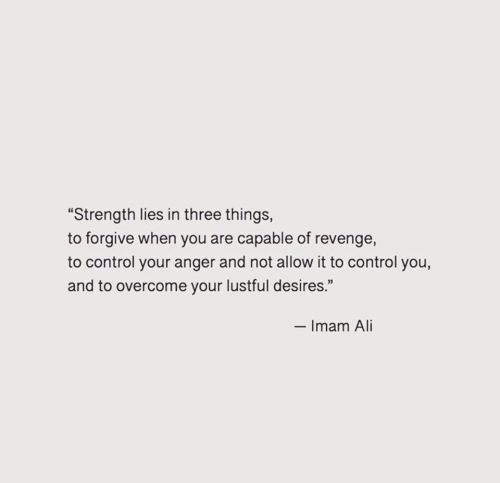
Posted by: Michael | 11/22/2019
Where Strength Lies – Imam Ali
Posted by: Michael | 11/21/2019
Sickness and Feeling Sorry
“Grief can be the garden of compassion. If you keep your heart open through everything, your pain can become your greatest ally in your life’s search for love and wisdom”― Rumi
So I’ve got a cold and feel pretty horrible. I also cut the heck out of my thumb yesterday which means I am reticent to do my normal exercise routine as the wound keeps opening when I put pressure on it. Suffice it to say that I’m feeling crappy and a tad melodramatic. I began looking for some teachings on turning our suffering (more specifically, sickness) into a springboard for cultivating compassion. I know there are some lojong teachings out there that fit the bill but this quote immediately came to mind.
May I use this sickness and suffering to reflect on the real sufferings of countless beings.
May I appreciate my lot and the opportunities I have that so many others do not.
May I not use this suffering as an excuse to inflate the sense of self.
Posted by: Michael | 11/20/2019
Happy Uposatha – Giving
Dhammapada Verse 224
Mahamoggallanapanha Vatthu
Saccam bhane na kujjheyya
dajja appampi yacito
etehi tihi thanehi
gacche devana santike.
Verse 224: One should speak the truth, one should not yield to anger, one should give when asked even if it is only a little. By means of these three, one may go to the world of the devas.
Sometimes I need a reminder that giving is always good and advisable, especially when I feel like I don’t have enough. And, when I take true stock, there has never been a time in this life when I haven’t.
May I always give even when I feel that I have little. May I never allow stinginess to win the day.
Posted in Bodhisattvayana, Buddha, Buddha Vacana, Buddhism, Dana, Dhamma, Theravada, Uposatha | Tags: devas, Dhammapada, giving
Posted by: Michael | 11/18/2019
Rest
I made a quick search in the Canon this morning and online for sutras that cover the topic of rest and came up with very little. Perhaps it’s because the training of the mind doesn’t require the same kind of rest that the body does or perhaps I’m just looking in the wrong places.
As I think about it, I recall that engaging in mettā or breath awareness (without jhana) can lead to weariness but I will need to look to see if this was Buddhavacana or in a secondary source. Perhaps it’s more of a question of changing one’s kammatthana more so than taking a break from all forms of mental training. Besides, whether it’s body or mind, it seems pretty clear that a state of pure rest can never exist.
What got me thinking about all of this is my daily routine of conditioning. I am realizing that I need to take at least two days off a week and have chosen the weekend to do so. I will probably just up my daily step goals on weekend days but will forego the more rigorous training. Similarly, when the practice is dry I should feel no guilt about finding a more inspiring object.
Posted in Buddha, Buddha Vacana, Buddhism, Dhamma, Theravada | Tags: mental culture, physical conditioning, recovery, rest
Posted by: Michael | 11/16/2019
Desire Keeps Us Bound
Posted by: Michael | 11/13/2019
Out of Control
My wife’s jobs as a doula and now midwife are such that she is called away with little notice. At most, she has a day advance warning that something is afoot. Unfortunately, or fortunately, one of my biggest challenges is dealing with interruptions to my schedule and, despite my best efforts, I have been able to do little more than stifle my outward reaction. She noticed I was displeased that my day was abruptly uprooted and rearranged and didn’t take it well. Of course there was consternation and screaming.
But, despite knowing how irrational my displeasure was I wasn’t able to feel differently. I told her I didn’t intend to say a word about it but she wanted me to “feel okay” with it too. Even taking full responsibility here doesn’t seem capable of resolving this issue but my dis-ease with a world that operates with sheer disregard for my own schedule is something I need to work on for myself as much as anyone else.
Posted in Buddha, Buddhism, Dhamma, Family Life, Theravada | Tags: children, marriage, uncertainty, work
Posted by: Michael | 11/12/2019
Thank You
I want to thank a reader of this blog who shared a book with me yesterday because they thought it might help my marital situation. I immediately found the audiobook on Scribd and began listening at work only to discover later that I had bought it and read a quarter of the way through sometime ago.
So, what is the book? Feeling Good Together by David Burns. I’m unsure why I gave it up before although I suspect it was a combination of factors including the fact that the method it outlines asks you to take complete responsibility for the issues on type relationship. Intuitively, I know this is the only sane approach but it took sitting with my doubts this morning to work it all out.
I realize that I need to constantly reframe our interactions with a view to my contribution to the difficulties. Beyond bare awareness of my wife’s contributions in word or deed I need to constantly refocus upon those things that are under my control at least in part: my thoughts, my feelings, my words and my deeds. At worst, by taking care of these things and ensuring that I do all things on line with the Dhamma, I can at least make peace with life and my wife. At best, by seeking to always take responsibility for the problems and to understand my wife’s perspective, we will be able to heal the relationship.
Thank you my friend and I intend to read and re-read the book and take its advice.
Posted in Buddha, Buddhism, Dhamma, Family Life, Forgiveness, Theravada | Tags: David Burns, Feeling Good Together, marriage
Posted by: Michael | 11/11/2019
Stingy Hearted
My hour long morning sessions have been pretty horrible in terms of collecting the mind. The only objects that seem to work for any length of time are the brahmaviharas and death recollection. So, I cycle through Buddho, brahmaviharas and maranasati again and again.
One thing that struck me this morning was how resistant the mind is to mudita. People for whom I have no problem mettā yet present real difficulties for appreciative joy practice. Clearly this is a problem in my own mind and has little to do with them. In fact, I could almost hear the plaintive cries of my ego lamenting about how unfair it is for another to have blessings that I don’t. It is a meanness and stinginess off heart that surprised me.
I figure the only way to do anything Scott it is to work with it so I hope to regularly do so during morning practice.
Posted in Buddha, Buddhism, Daily Practice, Dhamma, Formal Meditation, Maranasati, Metta, Mudita, Theravada | Tags: avarice, meanness, stingy
Posted by: Michael | 11/09/2019
Forgiveness and Strength
“The weak can never forgive. Forgiveness is the attribute of the strong.”
-Mahatma Gandhi
I was reminded of this quote by Facebook’s engagement algorithm this morning. I had originally shared the quote without attribution nine years ago so I went searching for it and found it was a Gandhi quote. I’m not quite sure if it’s encouraging to see that I’m still preoccupied by the same issues but there it is.
Forgiveness is hard and I can see how it really does take strength to prise open the hand of grasping to let go and wish well. I’m not trying to do great things by any stretch like Gandhi but I trust that forgiveness will do great things for me.
Posted in Buddha, Buddhism, Dhamma, Forgiveness, Theravada | Tags: compassion, Gandhi, letting-go
Posted by: Michael | 11/07/2019
Worldly Activities
You do not have to abandon worldly activities in order to attain effortless unconcern.
You should know that worldly activities and effortless unconcern are not two different things, but if you keep thinking about rejection and grasping, you make them two.
—Hui Neng
I saw this post on Ven. Tashi Nyima’s blog this morning and I found it fitting despite the fact that I’m always uneasy about prajnaparamita. Why? Simply because, in my mind, Zen/Chan is a finger finger pointing to the moon. It’s not the moon itself and it won’t tell you how to get there but it’s important to remind oneself of the goal from time to time.
For me, Theravada provides the blueprints and materials we need to build our own rocket ship to get there but it requires an awful lot of work which it’s why Zen and Pure Land are more popular. Who didn’t like the sound of sudden enlightenment? Better yet, who wouldn’t rather believe themself to already be liberated?
Categories
- Abhaya-cariya
- Abyapajjo homi
- Aditthana
- Anatta
- Anicca
- Anigho homi
- asubha
- bhavana
- Bodhisattvayana
- brahmacariya
- Buddha
- Buddha Vacana
- Buddhism
- Cheerfulness
- Confession of Fault
- Daily Practice
- Dana
- Devata
- Dhamma
- Dream Yoga | Lucid Dreaming
- Dukkha
- Family Life
- Fasting
- Forgiveness
- Formal Meditation
- Gratitude
- Islam
- Karuna
- Khanti
- Kwan Se Um
- Lojong
- mahayana
- Maranasati
- Maranassati
- maranānussati
- martial arts
- Meditation Word
- Metta
- Mudita
- Nekkhama
- pañña
- Parami
- Parisa Abhaya Dana
- Practice at Work
- Pure Land
- religio romana
- Restlessness and Remorse
- samadhi
- Samma Ajivo
- samma sankappo
- Samma Sāti
- samma vayamo
- Sammā Vācā
- Sangha
- Sensual Desire
- Seon
- Sila
- Stoicism
- Taṇhā
- Theravada
- Tibetan Buddhism
- Tisarana
- Upekkha
- Upekkha
- Uposatha
- Video
- Vipassana
- Zen


 Cattāri Brahmavihārā