Posted by: Michael | 12/02/2012

Giving Well Isn’t So Easy

image

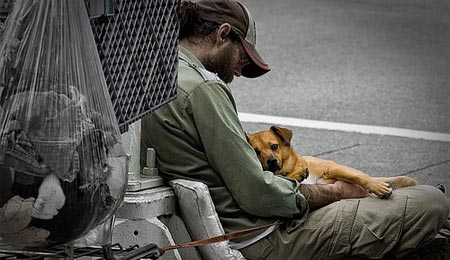
Today, inspired by yesterday’s reflctions, I decided to take my son out for a walk around the nieghborhood and look for people that we could give to. Sounds like a pretty easy proposition in the East Village doesn’t it? Well, it would be if it weren’t for me. It was funny to
watch but each time we came upon someone I would immediately evaluate their worthiness. I soon realized, much to my surprise, that I had very definite idea of who I wanted to give to: a dirty, preferrably older man or woman with all of their belongings in a shopping cart. Instead I found the punk rock street kid at 14th and Broadway to whom I could only bring myself to give a dollar or the junkies under the scaffold at 3rd Ave to whom I gave some bananas.

Needless to say, I was disappointed by my acts of charity as I had wanted to make a much grander gesture. It wasn’t until my son and I got back to First Ave that I found my ideal homeless person: an old man with a cart gingerly carrying a bowl of hot, microwave ramen in his hands. Ironically, when asked if there was anything I could get for him he politely declined.

So, I think the moral may be to give while you can and to whomever you can although today’s experience left me slightly confused and disturbed by the limits of my generosity. More grist for the mill I suppose.

Posted by: Michael | 12/02/2012

Merit Matters – Equanimity and Urgency

PunnaI listened to a Dhamma talk yesterday by a bhikkhu that I had never heard of before and was struck by something he said-actually it was the theme of his talk as whole which was why most beings end up in lower realms after their present life in the human or deva realms. In essence, the venerable stated that being born into the sugati (blissful) realms which include the human realms on up through the brahma realms  takes a lot of merit and as we live out our lives we burn through this merit like crazy. Now, because samsara has no discernible beginning it’s not as if we use up all of our merit but when the vast share of it that condition our apearance in the sugati realms is used up we often have a lot of bad kammic seeds just waiting to ripen. And, unsurprisingly, when things are going well many of us don’t bother with making a lot of merit or other good kamma–it’s only when the chips are down that many of us begin to try to act more skillfully. And, that is, in a nutshell why it is so easy to fall from a birth as a deva directly into hell.

Now, if your a secular Buddhist or not even Buddhist at all everything I just said my be a hard pill to swallow but it is pretty much the traditional understanding of kamma. In fact, without serious hermeneutic contortions it is hard to see how one could practice the 8FP or understand the 4NT although there are many out there who do it (I am not capable of such intellectual gymnastics personally). But, be that as it may: this bhikkhu at once brought me to a clearer understanding of what samvega and pasaddha might mean (see here for a great discussion on the subject by one of my favorite teachers: http://here-and-now.org/wwwArticles/samvega.html).

In other words, I can’t justify my complacency in thinking that since I was born into the human realm this time and had the great fortune to meet with the Dhamma I can pretty much coast on ahead without worrying too much (and, yes, I really have thought this way often in the past). But, I can simultaneously let go of my obsessive worrying about the future by accepting the fact that most of the things thatbefall me are a result of my kamma. Only through accepting with upekkha what is happening now can I hope to understand it  and no longer be captive to circumstance. For the umpteenth time the Dhamma has saved my life and I am inspired to make a resolve to make more merit through dana, sila and samadhi than I felt necessary before.

May we not squander the blessings of our lives and may we strive to realize the truth in this very life!

Related articles


Enhanced by Zemanta
Posted by: Michael | 11/30/2012

Wishing All Beings Well on the Sidewalk

May All Beings on the Sidewalk Be Well!Today’s post finds me in a much better state of mind thanks to good advice, saddha and a good night’s rest. I have been reading a piece by a sayadaw about rebirth and realized that one of the things that always helps me when I’m at my lowest is the recollection of death and impermanence. Nothing is so bad that it should drive us to despair or to cause harm as conditions will soon enough change and fall away.

So, how does this have to do with radiating metta? Well, in the article by the sayadaw he talks about the kamma that creates that next rebirth (please no abhidhammic or philosophical interjections as I’m speaking solely in conventional language). Sensibly he points out that whatever we practice often and has made the greatest impression upon us will be more likely to arise in our minds during the last moments of our life. I believe that much of my practice now is an attempt to return to the theme of the brahmaviharas for precisely this reason: that I may place my attention on a heart full of metta as I am dying. The other benefits are myriad but, being unable to devote myself to extended retreats atg present I feel I am doing what I can to prepare for a good death.

Which brings me back to the sidewalk: inspired by the article I read I undertook a practice which I have found energizing in the past to radiate loving-kindness to each person I see as I’m walking through the streets. In a city like NYC it can be a little overwhelming due to the shear number of people but it really helps snap me out of the normal state of mind. Sadly when I’m not consciuosly practicing I make snap judgements of each person I see: she’s attractive; he’s a junkie; she’s dirty; he looks like a jerk. When I practice metta towards everyone that steps into my field of vision and attempt to meet each one individually with a blessing the status quo is interrupted and the aversive judgements are short circuited. Pheww! What a mouthful but I really recommend giving it a try. May this be of some benefit!

Related articles

Enhanced by Zemanta

image

Some days (and for me it always seems to be the day after the uposatha) everything just feels wrong. All day today I have been racked with anxiety alternating with frustration and anger. At what: just about everything. The dire state of our world, the economy, family…you name it and I’m suffering from it today. What to do? Stick with it as best I can I suppose and try to do as little harm as possible until the poison runs out.

Posted by: Michael | 11/28/2012

Happy Anapanasati Day

Today is an observance day and a special one at that. Accordimg to the Thai Dhammayut calendar that I follow, today commemorates the day the Lord Buddha gave t Anapanasati Sutta for the first time. The importance of this sutta just cannot be understated especially for thos of us who received our spiritual education in the West from lay teachers primarily concerned with so-called secular meditation practices.

But, before I get ahead of myself and end up speaking to things of which I can have no direct knowledge let me back up and begin again. For me, practicing with the Anapanasati Sutta has comprised perhaps the greater part of my time as an upasaka and has borne the greatest results in term of formal meditation. That is to say that I have experienced deeper states of concentration while practicing breath meditation than with any other theme. And, although I have had difficulties with the practice this has mostly if not wholly been the result of my own kilesas getting in the way.

May we not squander the opportunities we have in this life to practice the Dhamma of the Lord Buddha and to learn from those who have gone forth in the sasana. May we practice for the benefit of ourselves and all beings and may we taste the Deathless in this very life!

Posted by: Michael | 11/27/2012

Sickness

Of the Four Divine Messengers I think it’s safe tto say that Sickness is the one that we are most often aware of in our daily lives. For some reason Aging and Death seem to be either abstractions or something that happens to other people (and ordaining as a Samana certainly doesn’t just happen). The immediacy of a head cold and the frequency with which sickness visits us (especially those of us with young children) make it a poignant reminder of our mortality in a society where it’s all too easy to imagine oneself free of the constraints of embodiment. At least, that is, when we hold our sickness correctly.

Usually when I get sick I view it as anything but an opportunity to contemplate the Dhamma. Rather I feel sorry for myself while simultaneously pushing through the illness, completely disregarding my body’s pleas for rest. So, how does one hold sickness in a way that befits a practicioner of the Dhamma? Until now I guess I never really thought about it except to criticize myself for my failure to do so. It seems to me now that sickness should be taken as a reminder of anicca and that all phenomena are anatta. This seems especially relevant to me as I often (if only semi-consciously) regard myself as little more than a worker drone that must always complete my tasks come hell or high-water with little regard for the fact that I don’t own or control this body or mind.

Another thing which occurs to me now is that when I’m sick (and, sadly, when others are sick around me) I have precious little compassion in my heart. Maybe, as I my symptoms progress from sniffles to a full blown cold I can do so tenderly and realize that this is the way of bodies so I might as well meet the experience with some metta, karuna and, when all else fails, upekkha.

May this be of some benefit.

Posted by: Michael | 11/26/2012

Disadvantages of Anger – An Impetus to Practice

image

The Dhamma talk that I chose yesterday as part of my Daily Practice Outline was a talk/guided meditation by Ajahn Viradhammo. Besides an inspiring coordination of the in and out breaths with metta radiation the thing that struck me most was his reminder that a good way to begin the practice is to dwell on the disadvantages of anger. In other words, what happens when loving-kindness is not the touchstone throughout the course of the day?

The Mettanimsamsa Sutta is a discourse which lists the 11 benefits of metta and is, therefore, the mirror image of what is recommended by the ajahn. I have found myself somewhat inspired to practice by contenplating the benefits listed and often chant the sutta duringb the evening but I have always been more easily motivated by the stick than the carrot.

With that in mind I’m on the hunt for a sutta that I can use to inspire my metta bhavana. If I can’t find that or a paritta then I will try to compile or compose my own. Any suggestions are certainly welcome and will be appreciated. Mettaya!

Posted by: Michael | 11/25/2012

Train Dhamma – Commuting for the Holidays

image

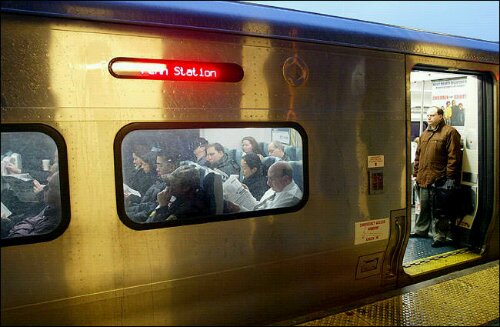
So, it’s the Sunday after Thanksgiving and my family is returning from the in-law’s by train along with thousands of other families. As usual my anxiety level is pretty high as I attempt to manage my kids in the confines of a packed train. At times like this I am thankful for the Kindle Fire despite my secret, Luddite leanings. Today I don’t feel the enmity from my fellow travelers nearly as much and that may be me or due to the fact that there’s no more expectation left: the holidays are over now.

Nonetheless, the animosity that I pick up on from others either as a generalized emotional milieu or specifically directed at me and/or my children is something I constantly struggle with. It’s a very base drive to react agressively when one feels that one’s children are threatened and I have experienced people doing just that on more than one occasion (thankfully it has only thus far been verbal). And, I must admit that I have yet to respond in a way that I can be proud. At such times the Simile of then Sa
w pops immediately to mind and I end up feeling doubly bad. So far my depth of practice has yet to plumb the depths of parental anxiety so I must resolve to do my best and practice well enough that it someday will.

Posted by: Michael | 11/24/2012

The Length of a Sitting – Tracking Your Progress

Adze


I think that for most of us who meditate webecome obsessed at some point or another with the length of time that we sit. I knowI am particularly bad about this and have spent years timing myself, setting goals and tracking my “progress.” What often gets swept under the rug (only as far as I’m concerned–I certainly can’t speak to any one else’s experience) is the fact that the only progress that’s really being tracked is the length of time spent in sitting.  And, although my average daily sitting time has slipped from its past heights of 50 minutes I feel that my attitude toward sitting has gotten much better.


Now, I’m not advocating that we sit only 5 minutes a day and call it quits but what I am saying is that we needn’t become so obsessed with hitting a certain number that we cause ourselves unnecessary suffering over it (something which I’m wont to do). For me, the one thing that has helped allay my anxiety over the length of each session is consistency of practice: I can count on myself to sit again and to put in effort. If my practice were not daily and I only had a day or to a week to devote to seated meditation I might find it considerably harder to be at ease with a 15 or 20 minute sit. But, if that were the case, I would need to learn t be a little kinder to myself wouldn’t I?


Anyway, the following from the Anguttara is one of my favorite teachings on the practice and how we should regard our practice when we become obsessed with measuring its results. May this be of some benefit!


Just as when a carpenter or carpenter’s apprentice sees the marks of his fingers or thumb on the handle of his adze but does not know, ‘Today my adze handle wore down this much, or yesterday it wore down that much, or the day before yesterday it wore down this much,’ still he knows it is worn through when it is worn through. In the same way, when a monk dwells devoting himself to development, he does not know, ‘Today my effluents wore down this much, or yesterday they wore down that much, or the day before yesterday they wore down this much,’ still he knows they are worn through when they are worn through.

— AN 7.67


Enhanced by Zemanta
Posted by: Michael | 11/23/2012

Black Friday

Black FridayMaybe it’s been the heedless eating over the past two days or the lack of seclusion for meditation and contemplation but I there is a certain feeling of disconnectedness that has been gnawing at me as I considered wha to write today. I spent most of today working remotely at my in-laws house surrounded by the sounds of children playing and crying. My wife and her sister and cousin actually braved the Black Friday crowds and have been gone for the better part of the day but it is only now after my own work was finished that I find myself “free” to write and reflect.

And although I don’t have much to say about today it is interesting for me to reflect on the almost insane abundance we enjoy and take for granted (listening to my nephew ask for ice, “sweet apples” and any other manner of things I was struck by how such requests would be impossible to fulfill for most children in the world) here and in this moment. Why can’t I eat, drink and be merry and be content with that? I suppose the most honest answer would be anicca: soon enough, if we don’t practice rightly, we will again be those very have-nots that we pity (or not) at present.

Anicca vata sankhara


Enhanced by Zemanta

« Newer Posts - Older Posts »

Categories

Brightening Futures of Zanzibar

Improving Lives through Generosity

Shillelagh Studies

A hub for the music, culture, knowledge, and practice of Irish stick-fighting, past and present.