Posted by: Michael | 03/09/2021

Dhammapada Memorization: Verse 21

21. Heedfulness is the path to the Deathless. Heedlessness is the path to death. The heedful die not. The heedless are as if dead already..

Please find the audio recording of this verse below. Please take the time to recite the following three times before reading the words of Lord Buddha:

Namo Tassa Bhagavato Arahato Sammā Sambudhassa (3 times).

Homage to the blessed One, the Perfected One, the Fully Awakened One (3 times).

https://drive.google.com/file/d/1qbWH5SCXE2ypMFqCBhz34WEkPEGjEl2b/view?usp=sharing

Be sure to repeat the verse, with the verse number at least ten times out loud. It helps if you can do this multiple times a day and use as many different techniques (writing, repetition, listening) as possible.

The Story of Samavati (from https://www.tipitaka.net/tipitaka/dhp/verseload.php?verse=021)

While residing at the Ghosita monastery near Kosambi, the Buddha uttered Verses (21), (22) and (23) of this book, with reference to Samavati, one of the chief queens of Udena, King of Kosambi.

Samavati had five hundred maids-of-honour staying with her at the palace; she also had a maid servant called Khujjuttara. The maid had to buy flowers for Samavati from the florist Sumana everyday. On one occasion, Khujjuttara had the opportunity to listen to a religious discourse delivered by the Buddha at the home of Sumana and she attained Sotapatti Fruition. She repeated the discourse of the Buddha to Samavati and the five hundred maids-of-honour, and they also attained Sotapatti Fruition. From that day, Khujjuttara did not have to do any menial work, but took the place of mother and teacher to Samavati. She listened to the discourses of the Buddha and repeated them to Samavati and her maids. In course of time, Khujjuttara mastered the Tipitaka.

Samavati and her maids wished very much to see the Buddha and pay obeisance to him; but they were afraid the king might be displeased with them. So, making holes in the walls of their palace, they looked through them and paid obeisance to the Buddha everyday as he was going to the houses of the three rich men, namely, Ghosaka, Kukkuta and Pavariya.

At that time, King Udena had also another chief queen by the name of Magandiya. She was the daughter of Magandiya, a brahmin. The brahmin seeing the Buddha one day thought the Buddha was the only person who was worthy of his very beautiful daughter. So, he hurriedly went off to fetch his wife and daughter and offered to give his daughter in marriage to the Buddha. Turning down his offer, the Buddha said, “Even after seeing Tanha, Arati and Raga, the daughters of Mara, I felt no desire in me for sensual pleasures; after all, what is this which is full of urine and filth and which I don’t like to touch even with my foot.”

On hearing those words of the Buddha, both the brahmin and his wife attained Anagami Magga and Phala. They entrusted their daughter to the care of her uncle and themselves joined the Order. Eventually, they attained arahatship. The Buddha knew from the beginning that the brahmin and his wife were destined to attain Anagami Fruition that very day, hence his reply to the brahmin in the above manner. However, the daughter Magandiya became very bitter and sore and she vowed to take revenge if and when an opportunity arose.

Later, her uncle presented Magandiya to King Udena and she became one of his chief queens. Magandiya came to learn about the arrival of the Buddha in Kosambi and about how Samavati and her maids paid obeisance to him through holes in the walls of their living quarters. So, she planned to take her revenge on the Buddha and to harm Samavati and her maids who were ardent devotees of the Buddha. Magandiya told the king that Samavati and her maids had made holes in the walls of their living quarters and that they had outside contacts and were disloyal to the king. King Udena saw the holes in the walls, but when the truth was told he did not get angry.

But Magandiya kept on trying to make the king believe Samavati was not loyal to him and was trying to kill him. On one occasion, knowing that the king would be visiting Samavati within the next few days and that he would be taking along his lute with him, Magandiya inserted a snake into the lute and closed the hole with a bunch of flowers. Magandiya followed King Udena to Samavati’s quarters after trying to stop him on the pretext that she had some presentiment and felt worried about his safety. At Samavati’s place Magandiya removed the bunch of flowers from the hole of the lute. The snake came out hissing and coiled itself on the bed. When the king saw the snake he believed Magandiya’s words that Samavati was trying to kill him. The king was furious. He commanded Samavati to stand and all her ladies to line up behind her. Then he fitted his bow with an arrow dipped in poison and shot the arrow. But Samavati and her ladies bore no ill wills towards the king and through the power of goodwill (metta), the arrow turned back, although an arrow shot by the king usually went even through a rock. Then, the king realized the innocence of Samavati and he gave her permission to invite the Buddha and his disciples to the palace for alms-food and for delivering discourses.

Magandiya realizing that none of her plans had materialized, made a final, infallible plan. She sent a message to her uncle with full instructions to go to Samavati’s place and burn down the building with all the women inside. As the house was burning, Samavati and her maids-of-honour, numbering five hundred, kept on meditating. Thus, some of them attained Sakadagami Fruition, and the rest attained Anagami Fruition.

As the news of the fire spread, the king rushed to the scene, but it was too late. He suspected that it was done at the instigation of Magandiya but he did not show that he was suspicious. Instead, he said, “While Samavati was alive I had been fearful and alert thinking I might be harmed by her; only now, my mind is at peace. Who could have done this? It must have been done only by someone who loves me very dearly.” Hearing this, Magandiya promptly admitted that it was she who had instructed her uncle to do it. Whereupon. the king pretended to be very pleased with her and said that he would do her a great favour, and honour all her relatives. So, the relatives were sent for and they came gladly. On arrival at the palace, all of them, including Magandiya, were seized and burnt in the palace court yard, by the order of the king.

When the Buddha was told about these two incidents, he said that those who are mindful do not die; but those who are negligent are as good as dead even while living.

Then the Buddha spoke in verse as follows:

Verse 21: Mindfulness is the way to the Deathless (Nibbana); unmindfulness is the way to Death. Those who are mindful do not die; those who are not mindful are as if already dead.
 
Verse 22: Fully comprehending this, the wise, who are mindful, rejoice in being mindful and find delight in the domain of the Noble Ones (Ariyas).
 
Verse 23: The wise, constantly cultivating Tranquillity and Insight Development Practice, being ever mindful and steadfastly striving, realize Nibbana: Nibbana, which is free from the bonds of yoga*; Nibbana, the Incomparable!

* The bonds of yoga are four in number, viz., sense-pleasures (kama), existence (bhava), wrong belief (ditthi) and ignorance of the Four Noble Truths (i.e., avijja).
Posted by: Michael | 03/09/2021

Dhammapada Memorization: Verse 20

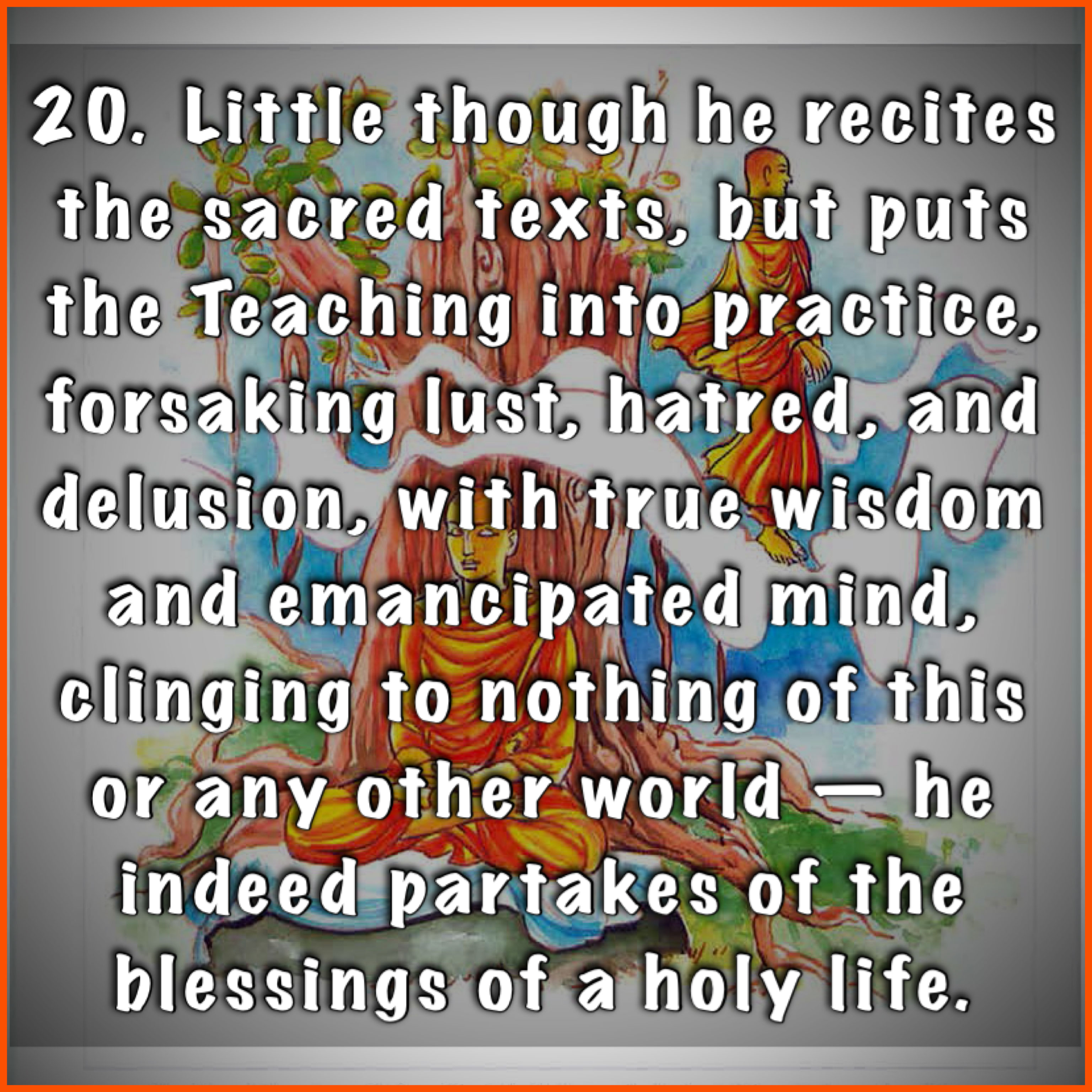
20. Little though he recites the sacred texts, but puts the Teaching into practice, forsaking lust, hatred, and delusion, with true wisdom and emancipated mind, clinging to nothing of this or any other world—he indeed partakes of the blessings of a holy life.

Please find the audio recording of this verse below. Please take the time to recite the following three times before reading the words of Lord Buddha:

Namo Tassa Bhagavato Arahato Sammā Sambudhassa (3 times).

Homage to the blessed One, the Perfected One, the Fully Awakened One (3 times).

https://drive.google.com/file/d/1qbWH5SCXE2ypMFqCBhz34WEkPEGjEl2b/view?usp=sharing

Be sure to repeat the verse, with the verse number at least ten times out loud. It helps if you can do this multiple times a day and use as many different techniques (writing, repetition, listening) as possible.

Posted by: Michael | 03/08/2021

Dhammapada Memorization: Verse 19

19. Much though he recites the sacred texts, but acts not accordingly, that heedless man is like a cowherd who only counts the cows of others—he does not partake of the blessings of the holy life.

Please find the audio recording of this verse below. Please take the time to recite the following three times before reading the words of Lord Buddha:

Namo Tassa Bhagavato Arahato Sammā Sambudhassa (3 times).

Homage to the blessed One, the Perfected One, the Fully Awakened One (3 times).

https://drive.google.com/file/d/1qbWH5SCXE2ypMFqCBhz34WEkPEGjEl2b/view?usp=sharing

Be sure to repeat the verse, with the verse number at least ten times out loud. It helps if you can do this multiple times a day and use as many different techniques (writing, repetition, listening) as possible.

Bahumpi ce samhita bhasamano
na takkaro hoti naro pamatto
gopova gavo ganayam paresam
na bhagava samannassa hoti.

Appampi ce samhita bhasamano
dhammassa hoti anudhammacari
raganca dosanca pahaya moham
sammappajano suvimuttacitto
1
anupadiyano idha va haram va
sa bhagava samannassa hoti.
2

Verse 19: Though he recites much the Sacred Texts (Tipitaka), but is negligent and does not practise according to the Dhamma, like a cowherd who counts the cattle of others, he has no share in the benefits of the life of a bhikkhu (i.e., Magga-phala).

Verse 20: Though he recites only a little of the Sacred Texts (Tipitaka), but practises according to the Dhamma, eradicating passion, ill will and ignorance, clearly comprehending the Dhamma, with his mind freed from moral defilements and no longer clinging to this world or to the next, he shares the benefits of the life of a bhikkhu (i.e., Magga-phala).


1. suvimuttacitto: Mind freed from moral defilements; this has been achieved through perfect practice and clear comprehension of the Dhamma.

2. sa bhagava samannassa hoti: lit., shares the benefits of the life of a samana (a bhikkhu). According to the Commentary, in this context, it means, “Shares the benefits of Magga-phala.”


The Story of Two Friends

While residing at the Jetavana monastery, the Buddha uttered Verses (19) and (20) of this book, with reference to two bhikkhus who were friends.

Once there were two friends of noble family, two bhikkhus from Savatthi. One of them learned the Tipitaka and was very proficient in reciting and preaching the sacred texts. He taught five hundred bhikkhus and became the instructor of eighteen groups of bhikkhus. The other bhikkhu striving diligently and ardently in the course of Insight Meditation attained arahatship together with Analytical Insight.

On one occasion, when the second bhikkhu came to pay homage to the Buddha, at the Jetavana monastery, the two bhikkhus met. The master of the Tipitaka did not realize that the other had already become an arahat. He looked down on the other, thinking that this old bhikkhu knew very little of the sacred texts, not even one out of the five Nikayas or one out of the three Pitakas. So he thought of putting questions to the other, and thus embarass him. The Buddha knew about his unkind intention and he also knew that as a result of giving trouble to such a noble disciple of his, the learned bhikkhu would be reborn in a lower world.

So, out of compassion, the Buddha visited the two bhikkhus to prevent the scholar from questioning the other bhikkhu. The Buddha himself did the questioning. He put questions on jhanas and maggas to the master of the Tipitaka; but he could not answer them because he had not practised what he had taught. The other bhikkhu, having practised the Dhamma and having attained arahatship, could answer all the questions. The Buddha praised the one who practised the Dhamma (i.e., a vipassaka), but not a single word of praise was spoken for the learned scholar (i.e., a ganthika).

The resident disciples could not understand why the Buddha had words of praise for the old bhikkhu and not for their learned teacher. So, the Buddha explained the matter to them. The scholar who knows a great deal but does not practise in accordance with the Dhamma is like a cowherd, who looks after the cows for wages, while the one who practises in accordance with the Dhamrna is like the owner who enjoys the five kinds of produce of the cows*. Thus, the scholar enjoys only the services rendered to him by his pupils but not the benefits of Magga-phala. The other bhikkhu, though he knows little and recites only a little of the sacred texts, having clearly comprehended the essence of the Dhamma and having practised diligently and strenuously, is an ‘anudhammacari‘**, who has eradicated passion, ill will and ignorance. His mind being totally freed from moral delilements and from all attachments to this world as well as to the next, he truly shares the benefits of Magga-phala.

https://www.tipitaka.net/tipitaka/dhp/verseload.php?verse=019

Posted by: Michael | 03/07/2021

Giving Up My Preferences

I lost my cool last night and told my wife to please shut her mouth as she was yelling at me. I’m ashamed that I both spoke harshly and, even more so, that I failed to live by my own values. Perhaps there is a silver lining though.

The whole argument started because my son and I had to reschedule our boxing lessons and there was a misunderstanding. Rather than simply sacrifice my time when my wife suddenly proposed she wanted to go running at that hour, I stood my ground and gained two fistfuls of resentment and bad kamma.

So, did I gain anything by putting my desires first? Clearly not. As such I’ll be making anew determination:

May I cheerfully sacrifice my plans whenever asked to do so.

May I give up my preferences without making a show of my sacrifice and take the opportunity to cultivate equanimity and suppleness of mind.

Posted by: Michael | 03/06/2021

Dhammapada Memorization: Verse 18

18. The doer of good delights here and hereafter; he delights in both the worlds. The thought, “Good have I done,” delights him, and he delights even more when gone to realms of bliss.

Please find the audio recording of this verse below. Please take the time to recite the following three times before reading the words of Lord Buddha:

Namo Tassa Bhagavato Arahato Sammā Sambudhassa (3 times).

Homage to the blessed One, the Perfected One, the Fully Awakened One (3 times).

https://drive.google.com/file/d/1qbWH5SCXE2ypMFqCBhz34WEkPEGjEl2b/view?usp=sharing

Be sure to repeat the verse, with the verse number at least ten times out loud. It helps if you can do this multiple times a day and use as many different techniques (writing, repetition, listening) as possible.

Dhammapada verses 17 & 18

Posted on January 29, 2020 by lynnjkelly

One who does evil is tormented in this life,
Tormented in the next,
Is tormented in both worlds.
Here he is tormented, knowing, “I have done evil.”
Reborn in realms of woe, he is tormented all the more.

One who makes merit is delighted in this life,
Delighted in the next,
Is delighted in both worlds.
Here she is delighted, knowing, “I have made merit.”
Reborn in realms of bliss, she delights all the more.
(translated by Gil Fronsdal)

These verses are almost the same as verses 15 & 16, with the more intense “being tormented” rather than “grieving” and substituting “is delighted” for “rejoices”. They also make explicit that the conscience of one who has “done evil” troubles her, and the knowledge that she has made merit brings delight. So the self-reflective activity is highlighted.

The Buddha points to two mental qualities as the underlying safeguards of morality, thus as the protectors of both the individual and society as a whole. These two qualities are called in Pali hiri and ottappa. Hiri is an innate sense of shame over moral transgression; ottappa is moral dread, fear of the results of wrongdoing. The Buddha calls these two states the bright guardians of the world (sukka lokapala).  …

In the present-day world, with its secularization of all values, such notions as shame and fear of wrong are bound to appear antiquated, relics from a puritanical past when superstition and dogma manacled our rights to uninhibited self-expression. Yet the Buddha’s stress on the importance of hiri and ottappa was based on a deep insight into the different potentialities of human nature. He saw that the path to deliverance is a struggle against the current, and that if we are to unfold the mind’s capacities for wisdom, purity and peace, then we need to keep the powderkeg of the defilements under the watchful eyes of diligent sentinels. (Bhikkhu Bodhi, from https://www.accesstoinsight.org/lib/authors/bodhi/bps-essay_23.html)

We could say that hiri is our conscience, the internal snag we hit when we know we’ve done the wrong thing, and ottappa is our fear of others knowing and reacting to an immoral deed we’ve done. All of us have these qualities in some degree. It might be useful to consider whether either hiri or ottappa or both act as “guardians” of our actions. No one else is charged with evaluating our behavior – it’s up to us to be our own monitors and teachers.

The verses refer to the lasting effects of both good and bad deeds. Each of us has sufficient inner wisdom to know that we are constantly rubbing up against each other with either kindly or hostile (or defensive) intent. Which face do we bring to others when we meet them? What tone of voice do we use internally? It is likely that we are similarly friendly or unfriendly to others as we are to ourselves. Can we soften our approach? Can we follow our more generous and forgiving instincts and set aside our combative ones, at least some (or more) of the time?

Posted by: Michael | 03/05/2021

Dhammapada Memorization: Verse 17

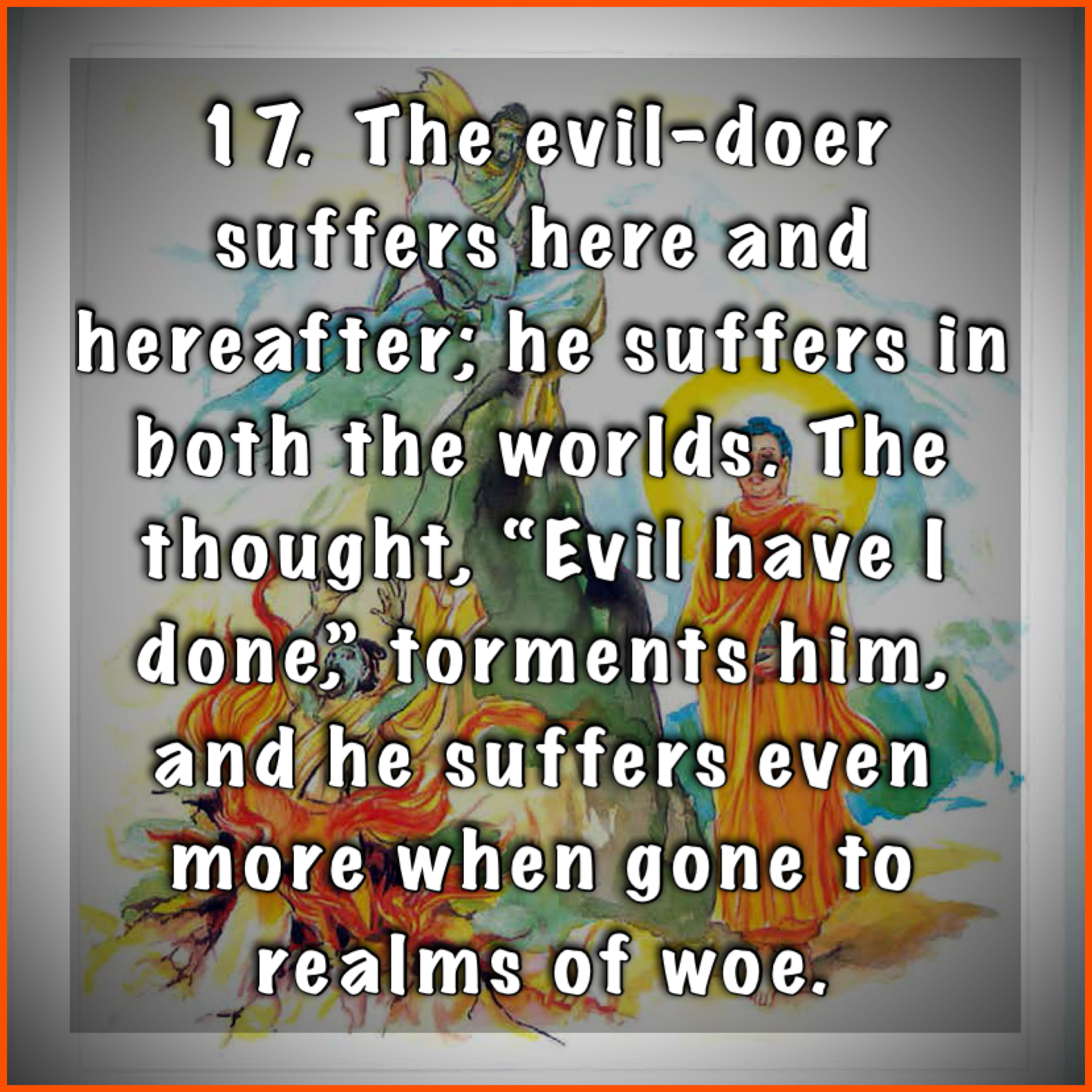
17. The evil-doer suffers here and hereafter; he suffers in both the worlds. The thought, “Evil have I done,” torments him, and he suffers even more when gone to realms of woe.

Please find the audio recording of this verse below. Please take the time to recite the following three times before reading the words of Lord Buddha:

Namo Tassa Bhagavato Arahato Sammā Sambudhassa (3 times).

Homage to the blessed One, the Perfected One, the Fully Awakened One (3 times).

https://drive.google.com/file/d/1qbWH5SCXE2ypMFqCBhz34WEkPEGjEl2b/view?usp=sharing

Be sure to repeat the verse, with the verse number at least ten times out loud. It helps if you can do this multiple times a day and use as many different techniques (writing, repetition, listening) as possible.

The Illustrated Dhammapada, Treasury of Truth, gives the following context and explanation for this verse of the Dhammapada:

Verse 17. Evil Action Leads to Torment

Here one burns, one burns hereafter,
in both ways does the evil-doer burn;
evil I’ve done, remorsefully one burns,
and more one burns passed to realms of woe.

Explanation: Those who do evil, those given to wrong doings, are tortured in mind both here and hereafter. Being born in a state of woe after death the doer of evil keeps on torturing himself more with the thought “I have done evil deeds. “

Posted by: Michael | 03/04/2021

Dhammapada Memorization: Verse 16

16. The doer of good rejoices here and hereafter; he rejoices in both the worlds. He rejoices and exults, recollecting his own pure deeds.

Please find the audio recording of this verse below. Please take the time to recite the following three times before reading the words of Lord Buddha:

Namo Tassa Bhagavato Arahato Sammā Sambudhassa (3 times).

Homage to the blessed One, the Perfected One, the Fully Awakened One (3 times).

https://drive.google.com/file/d/1qbWH5SCXE2ypMFqCBhz34WEkPEGjEl2b/view?usp=sharing

Be sure to repeat the verse, with the verse number at least ten times out loud. It helps if you can do this multiple times a day and use as many different techniques (writing, repetition, listening) as possible.

The Illustrated Dhammapada, Treasury of Truth, gives the following context and explanation for this verse of the Dhammapada:

Verse 16. Good Deeds Bring Happiness

Here one joys, one joys hereafter,
in both ways does the merit-maker joy;
one joys and one rejoices,
one’s own pure kammas seeing.

Explanation: A wise person does good deeds. Having done those good deeds he rejoices here in this world. He rejoices in the life after as well. Seeing the purity of his virtuous actions, he rejoices. He is thoroughly joyous seeing the goodness of his deeds.

Posted by: Michael | 03/03/2021

Dhammapada Memorization: Verse 15

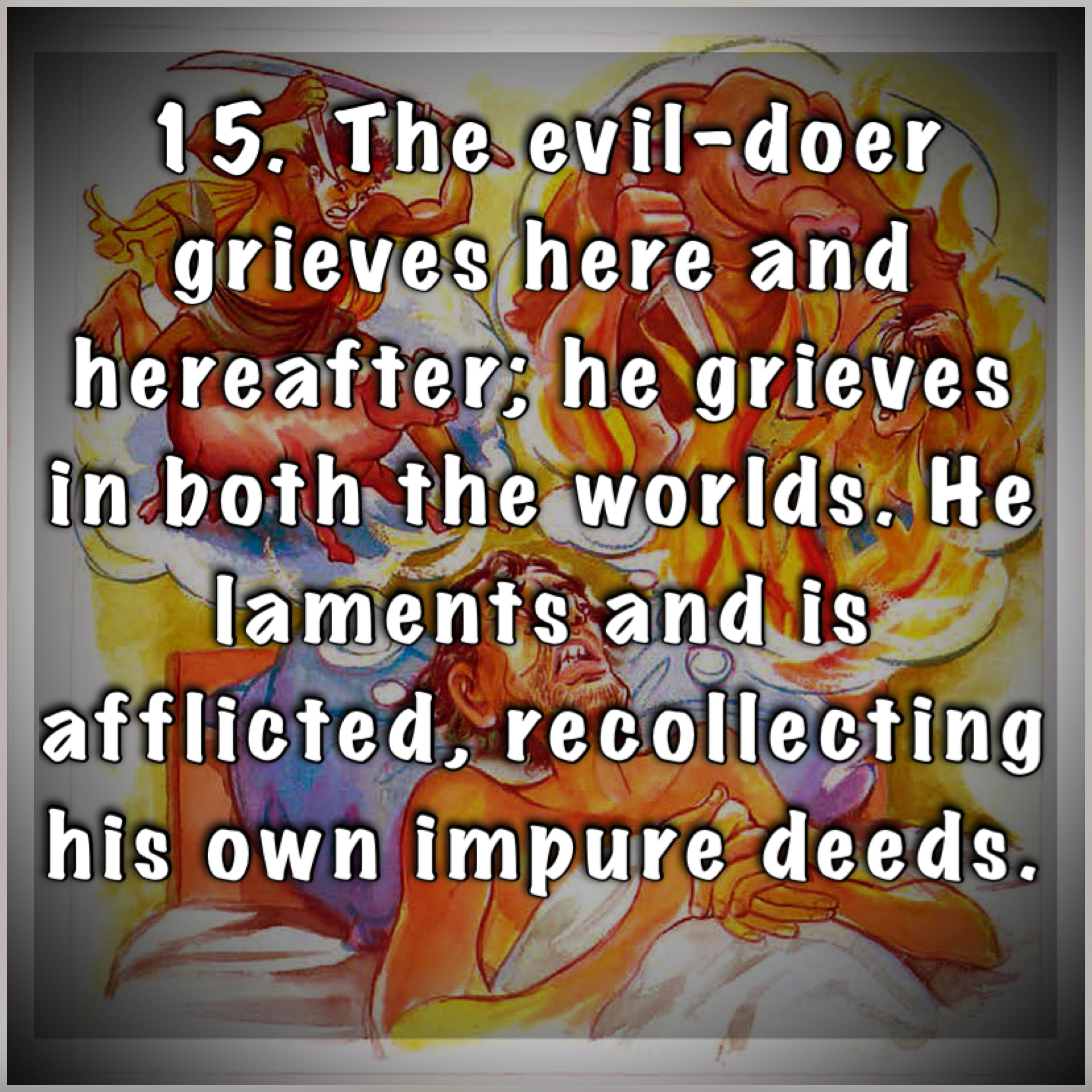
15. The evil-doer grieves here and hereafter; he grieves in both the worlds. He laments and is afflicted, recollecting his own impure deeds.

Please find the audio recording of this verse below. Please take the time to recite the following three times before reading the words of Lord Buddha:

Namo Tassa Bhagavato Arahato Sammā Sambudhassa (3 times).

Homage to the blessed One, the Perfected One, the Fully Awakened One (3 times).

https://drive.google.com/file/d/1qbWH5SCXE2ypMFqCBhz34WEkPEGjEl2b/view?usp=sharing

Be sure to repeat the verse, with the verse number at least ten times out loud. It helps if you can do this multiple times a day and use as many different techniques (writing, repetition, listening) as possible.

The Illustrated Dhammapada, Treasury of Truth, gives the following context and explanation for this verse of the Dhammapada:

Verse 15. Sorrow Springs From Evil Deeds

Here one grieves, one grieves hereafter,
in both ways does the evil-doer grieve;
one grieves and is afflicted,
one’s own base kammas seeing.

Explanation: People who commit evil actions are unaware of their consequences at the moment of performance. Therefore, they tend to repent on seeing the consequences of what they did. This creates grief. This does not mean that one must always suffer the consequences of one’s deeds, without any hope. If that is the case, there is no benefit in leading a religious life, nor is there any opportunity to work for one’s emancipation.

Posted by: Michael | 03/01/2021

Dhammapada Memorization: Verse 14

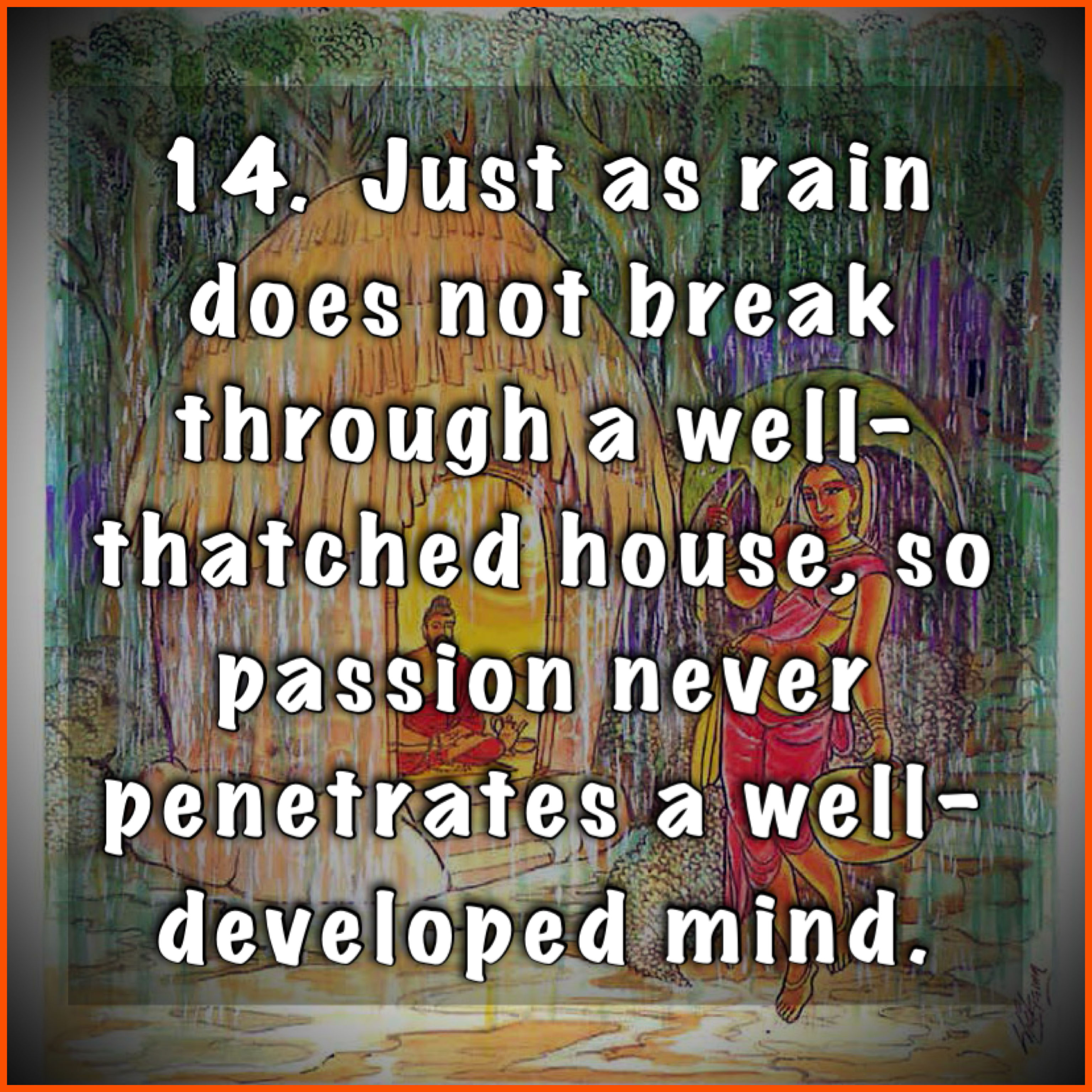
14. Just as rain does not break through a well-thatched house, so passion never penetrates a well-developed mind.

Please find the audio recording of this verse below. Please take the time to recite the following three times before reading the words of Lord Buddha:

Namo Tassa Bhagavato Arahato Sammā Sambudhassa (3 times).

Homage to the blessed One, the Perfected One, the Fully Awakened One (3 times).

https://drive.google.com/file/d/1qbWH5SCXE2ypMFqCBhz34WEkPEGjEl2b/view?usp=sharing

Be sure to repeat the verse, with the verse number at least ten times out loud. It helps if you can do this multiple times a day and use as many different techniques (writing, repetition, listening) as possible.

The Illustrated Dhammapada, Treasury of Truth, gives the following context and explanation for this verse of the Dhammapada:

Verse 14. The Disciplined Mind Keeps Lust Away

As rain does never penetrate
a house that is well-thatched,
so lust does never penetrate
the mind well cultivated.

Explanation: When the house is well protected by a well-thatched roof, it is not harmed by the rain, because rain-water cannot seep though it. In the same way, the well-cultured temperament too does not allow passion to come through. Therefore, the well-cultured temperament cannot be penetrated by passions.

Posted by: Michael | 03/01/2021

Dhammapada Memorization: Verse 13

13. Just as rain breaks through an ill-thatched house, so passion penetrates an undeveloped mind.

Please find the audio recording of this verse below. Please take the time to recite the following three times before reading the words of Lord Buddha:

Namo Tassa Bhagavato Arahato Sammā Sambudhassa (3 times).

Homage to the blessed One, the Perfected One, the Fully Awakened One (3 times).

https://drive.google.com/file/d/1qbWH5SCXE2ypMFqCBhz34WEkPEGjEl2b/view?usp=sharing

Be sure to repeat the verse, with the verse number at least ten times out loud. It helps if you can do this multiple times a day and use as many different techniques (writing, repetition, listening) as possible.

The Illustrated Dhammapada, Treasury of Truth, gives the following context and explanation for this verse of the Dhammapada:

Verse 13. Lust Penetrates Untrained Mind

Even as the rain does penetrate
a house that’s badly thatched,
likewise lust does penetrate
the mind uncultivated.

Explanation: It is quite necessary that a house should have a well-thatched roof. If the thatching is weak, rain seeps through the house. Just as a badly thatched roof lets in the rain, the uncultured temperament too is open to passions. The temperament that is not cultured is penetrated easily by lust.

From the Barre Center for Buddhist Studies:

The notion of developing the mind lies at the heart of the Buddhist tradition. Development (literally “causing to be”) has to do with strengthening the ability to focus, to stabilize, and to direct the mind, rather than allowing it to be carried off by whatever breezes waft in upon it from the senses or from its own unconscious. The question is whether your mind controls you or you control your mind. If your intention is to keep your attention on the breath, but it wanders off at the slightest provocation, then your ability to focus the mind is undeveloped. Yet remaining focused on a chosen object is a skill that can be learned, like any other, by practice, patient repetition, and gradual development.

Commentary:

In this case the skill developed is the ability to resist or deflect the influence of passion (raga), a word used more or less synonymously with desire, craving, attachment, etc. and thus the core cause of suffering. The effectiveness of a well-thatched roof (as they all were in those days) lies in its ability to deflect moisture and protect the contents of the house from getting soaked. By analogy, a well-developed mind will be aware of an unwholesome emotion that has arisen, for example, or a provocative sense input, but will allow these to roll off the mind and not penetrate into ensuing mind moments to drench the mind with clinging. A similar image often used in early Buddhist literature is of water rolling off a lotus leaf or the feathers of a duck.

When mindfulness of the body is well developed, conceptual thoughts will not penetrate; when loving kindness is well developed, aversion will not penetrate; when insight is well developed, ignorance and confusion will not penetrate. In short, when the mind is well developed, all its functions will be well shielded from the intrusion of suffering.

From: https://www.buddhistinquiry.org/article/dhammapada-13/

Memorize By Heart app: https://memorizebyheart.app/

« Newer Posts - Older Posts »

Categories

Brightening Futures of Zanzibar

Improving Lives through Generosity

Shillelagh Studies

A hub for the music, culture, knowledge, and practice of Irish stick-fighting, past and present.