Be sure to repeat the verse, with the verse number at least ten times out loud. It helps if you can do this multiple times a day and use as many different techniques (writing, repetition, listening) as possible.
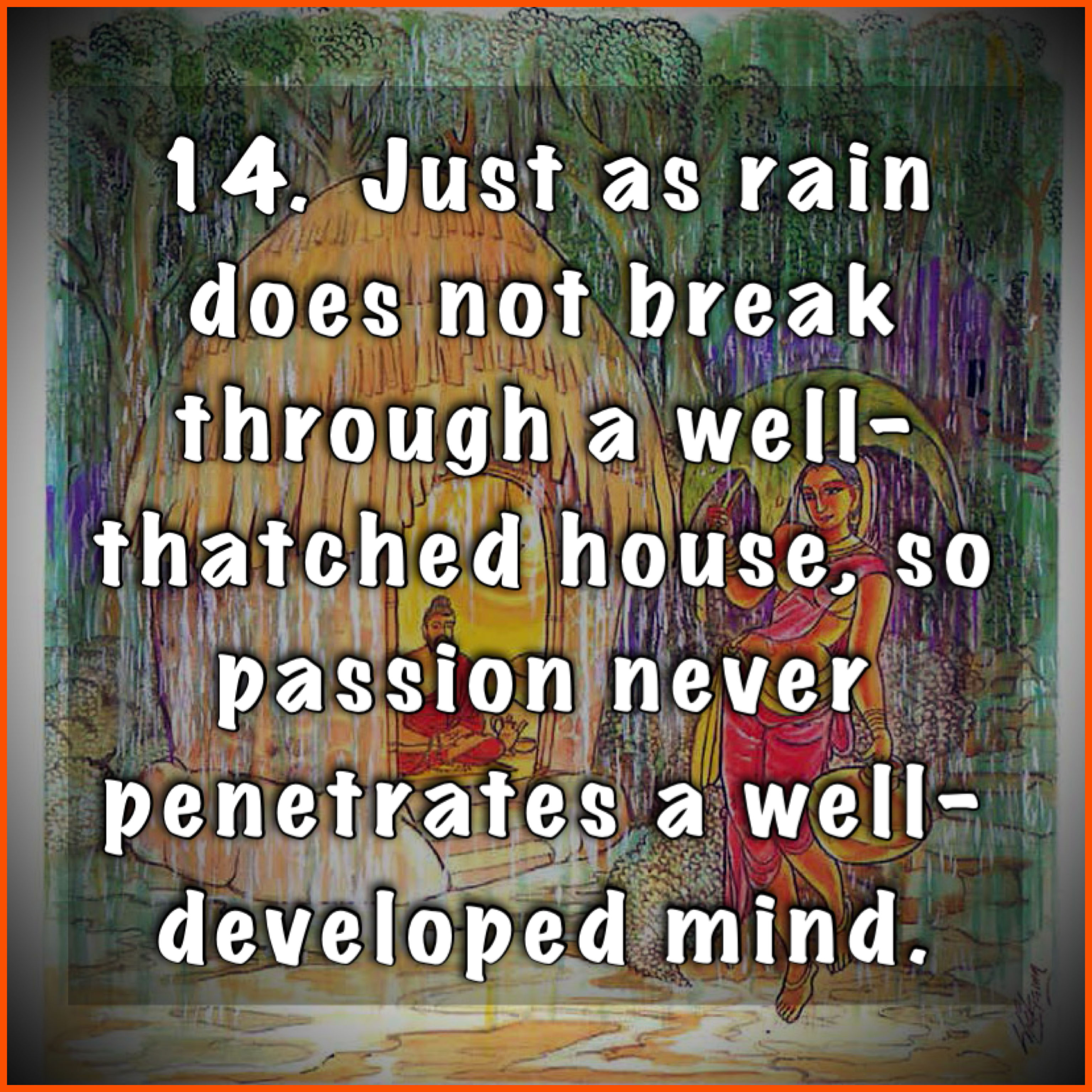
As rain does never penetrate a house that is well-thatched, so lust does never penetrate the mind well cultivated.
Explanation: When the house is well protected by a well-thatched roof, it is not harmed by the rain, because rain-water cannot seep though it. In the same way, the well-cultured temperament too does not allow passion to come through. Therefore, the well-cultured temperament cannot be penetrated by passions.
Be sure to repeat the verse, with the verse number at least ten times out loud. It helps if you can do this multiple times a day and use as many different techniques (writing, repetition, listening) as possible.
Even as the rain does penetrate a house that’s badly thatched, likewise lust does penetrate the mind uncultivated.
Explanation: It is quite necessary that a house should have a well-thatched roof. If the thatching is weak, rain seeps through the house. Just as a badly thatched roof lets in the rain, the uncultured temperament too is open to passions. The temperament that is not cultured is penetrated easily by lust.
From the Barre Center for Buddhist Studies:
The notion of developing the mind lies at the heart of the Buddhist tradition. Development (literally “causing to be”) has to do with strengthening the ability to focus, to stabilize, and to direct the mind, rather than allowing it to be carried off by whatever breezes waft in upon it from the senses or from its own unconscious. The question is whether your mind controls you or you control your mind. If your intention is to keep your attention on the breath, but it wanders off at the slightest provocation, then your ability to focus the mind is undeveloped. Yet remaining focused on a chosen object is a skill that can be learned, like any other, by practice, patient repetition, and gradual development.
Commentary:
In this case the skill developed is the ability to resist or deflect the influence of passion (raga), a word used more or less synonymously with desire, craving, attachment, etc. and thus the core cause of suffering. The effectiveness of a well-thatched roof (as they all were in those days) lies in its ability to deflect moisture and protect the contents of the house from getting soaked. By analogy, a well-developed mind will be aware of an unwholesome emotion that has arisen, for example, or a provocative sense input, but will allow these to roll off the mind and not penetrate into ensuing mind moments to drench the mind with clinging. A similar image often used in early Buddhist literature is of water rolling off a lotus leaf or the feathers of a duck.
When mindfulness of the body is well developed, conceptual thoughts will not penetrate; when loving kindness is well developed, aversion will not penetrate; when insight is well developed, ignorance and confusion will not penetrate. In short, when the mind is well developed, all its functions will be well shielded from the intrusion of suffering.
Be sure to repeat the verse, with the verse number at least ten times out loud. It helps if you can do this multiple times a day and use as many different techniques (writing, repetition, listening) as possible.
That which is real they know as real, that unreal, to be unreal; roaming fields of thought well-formed they at the real arrive.
Explanation: The wise person who is able to recognize the true values leading to spiritual attainment, is capable of attaining to spiritual heights. Such a person is possessed of right views.
Be sure to repeat the verse, with the verse number at least ten times out loud. It helps if you can do this multiple times a day and use as many different techniques (writing, repetition, listening) as possible.
Conceiving the real in unreality while seeing unreal the truly real, roaming fields of thoughts ill-formed: never they at the real arrive.
Explanation: A person interested in spiritual progress must be aware of spiritual values. It is true that material things are also necessary. But they are not the values to be sought after for spiritual progress. If people were to give prominence to material values they cannot attain any spiritual heights.
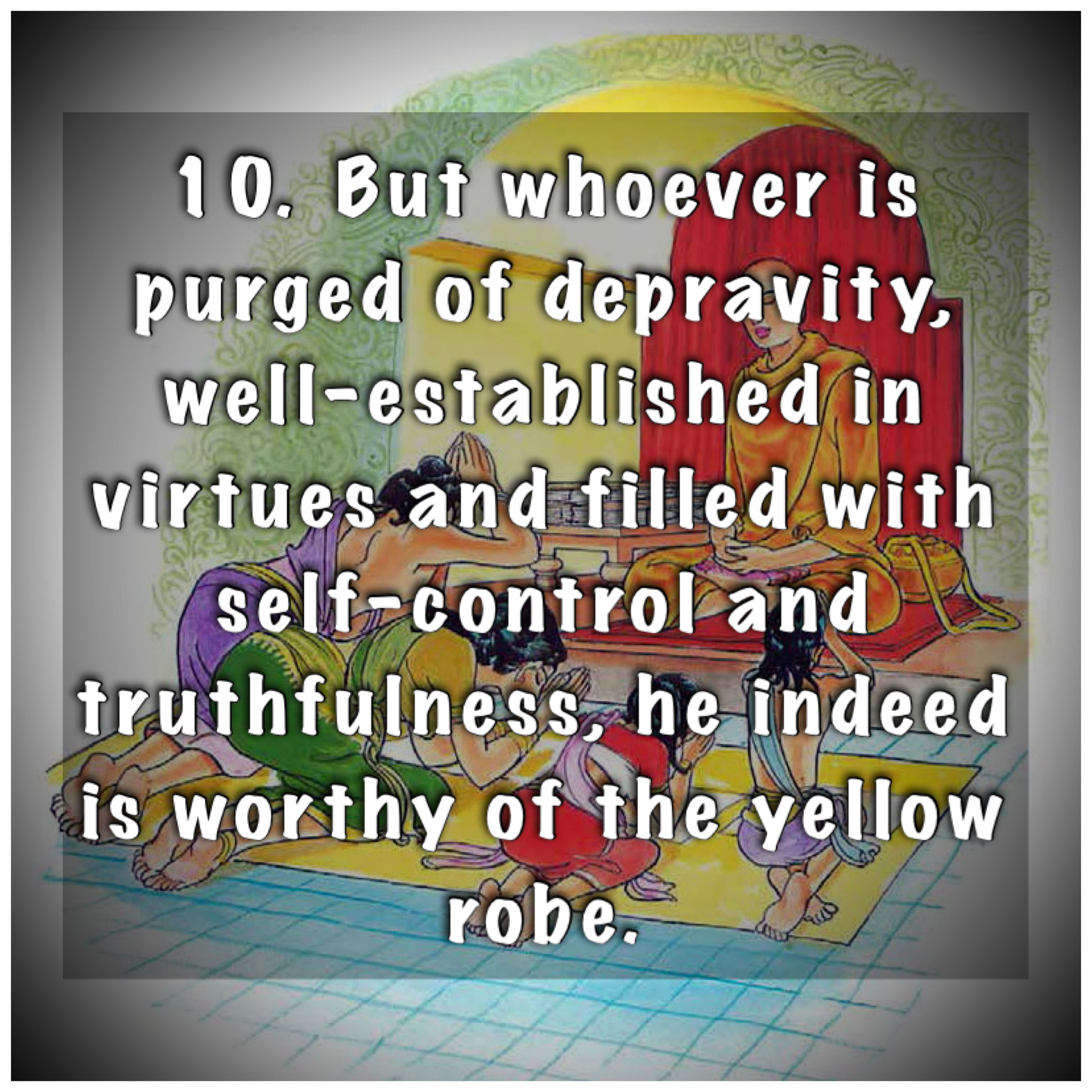
10. But whoever is purged of depravity, well-established in virtues and filled with self-control and truthfulness, he indeed is worthy of the yellow robe.
Please find the audio recording of this verse below. Please take the time to recite the following three times before reading the words of Lord Buddha:
Namo Tassa Bhagavato Arahato Sammā Sambudhassa (3 times).
Homage to the blessed One, the Perfected One, the Fully Awakened One (3 times).
Be sure to repeat the verse, with the verse number at least ten times out loud. It helps if you can do this multiple times a day and use as many different techniques (writing, repetition, listening) as possible.
But one who is self-cleansed of stain, in moral conduct firmly set, having restraint and truthfulness is fit for the stainless robe.
Explanation: Whoever dons the ‘stained cloth’, being free of defilements, who is well conducted and tranquil within, having emotions under control and aware of reality, such a person is worthy of the sacred ‘stained cloth’.
Be sure to repeat the verse, with the verse number at least ten times out loud. It helps if you can do this multiple times a day and use as many different techniques (writing, repetition, listening) as possible.
Verse 9. Those Who Do Not Deserve the Stained Robe
One who wears the stainless robe who’s yet not free from stain, without restraint and truthfulness for the stainless robe’s unfit.
Explanation: A monk may be stained by defilements, bereft of self-control and awareness of reality. Such a monk, though he may wear the ‘stained cloth’ ( the monk’s robe which has been specially coloured with dye obtained from wild plants), he is not worthy of such a saintly garb.
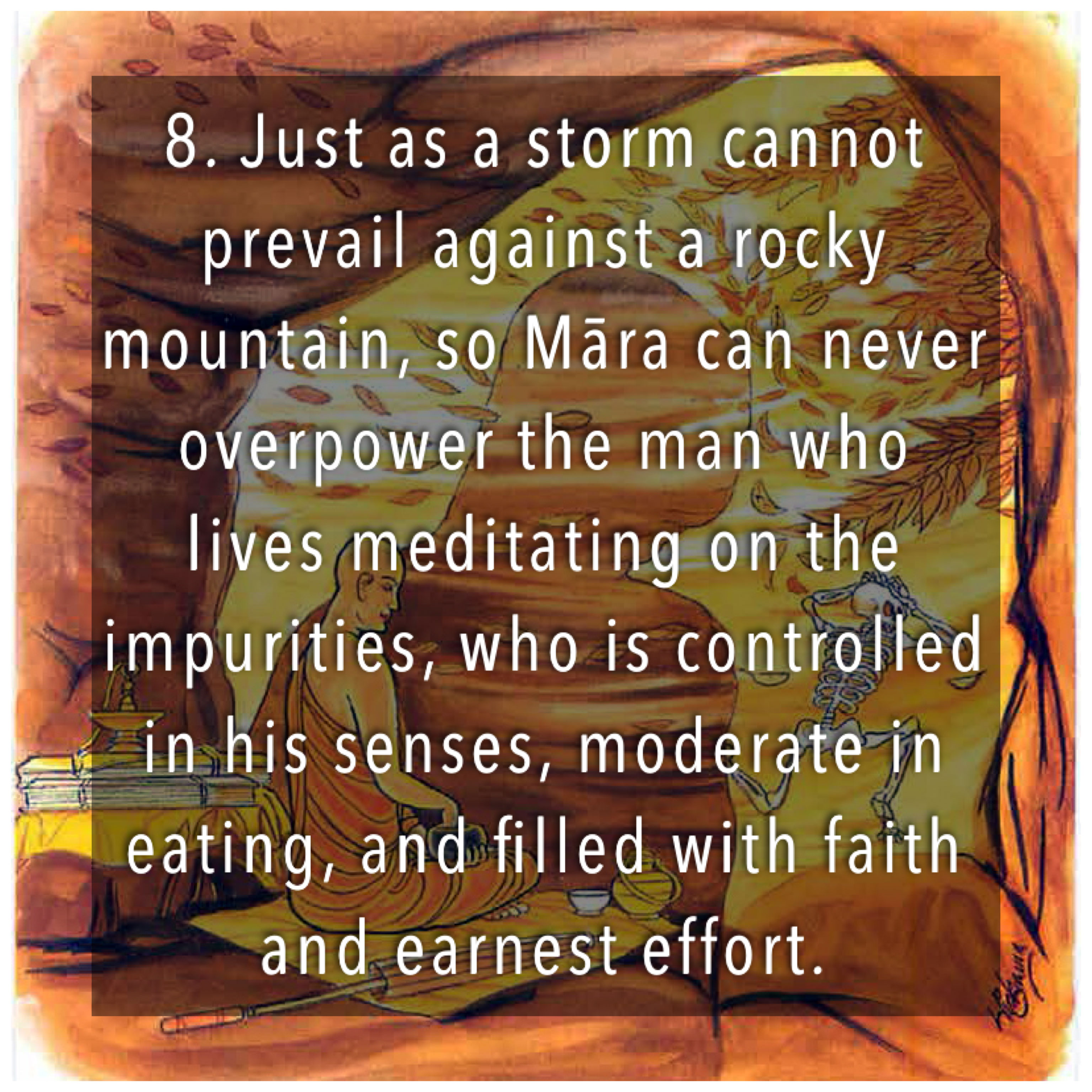
8. Just as a storm cannot prevail against a rocky mountain, so Mara can never overpower the man who lives meditating on the impurities, who is controlled in his senses, moderate in eating, and filled with faith and earnest effort.
Please find the audio recording of this verse below. Please take the time to recite the following three times before reading the words of Lord Buddha:
Namo Tassa Bhagavato Arahato Sammā Sambudhassa (3 times).
Homage to the blessed One, the Perfected One, the Fully Awakened One (3 times).
Be sure to repeat the verse, with the verse number at least ten times out loud. It helps if you can do this multiple times a day and use as many different techniques (writing, repetition, listening) as possible.
One who foulness contemplates, whose faculties are well-restrained, in food does moderation know, is full of faith, who’s diligent: that one no Mara overthrows, as wind does not a rocky mount.
Explanation: Those who dwell on the unattractiveness of sensual enjoyment, and live with the senses well guarded, and are moderate in eating, they are devoted to the Teaching and to persistent methodical practice. Such persons are not overpowered by emotions just as a rocky mountain is not shaken by the wind.
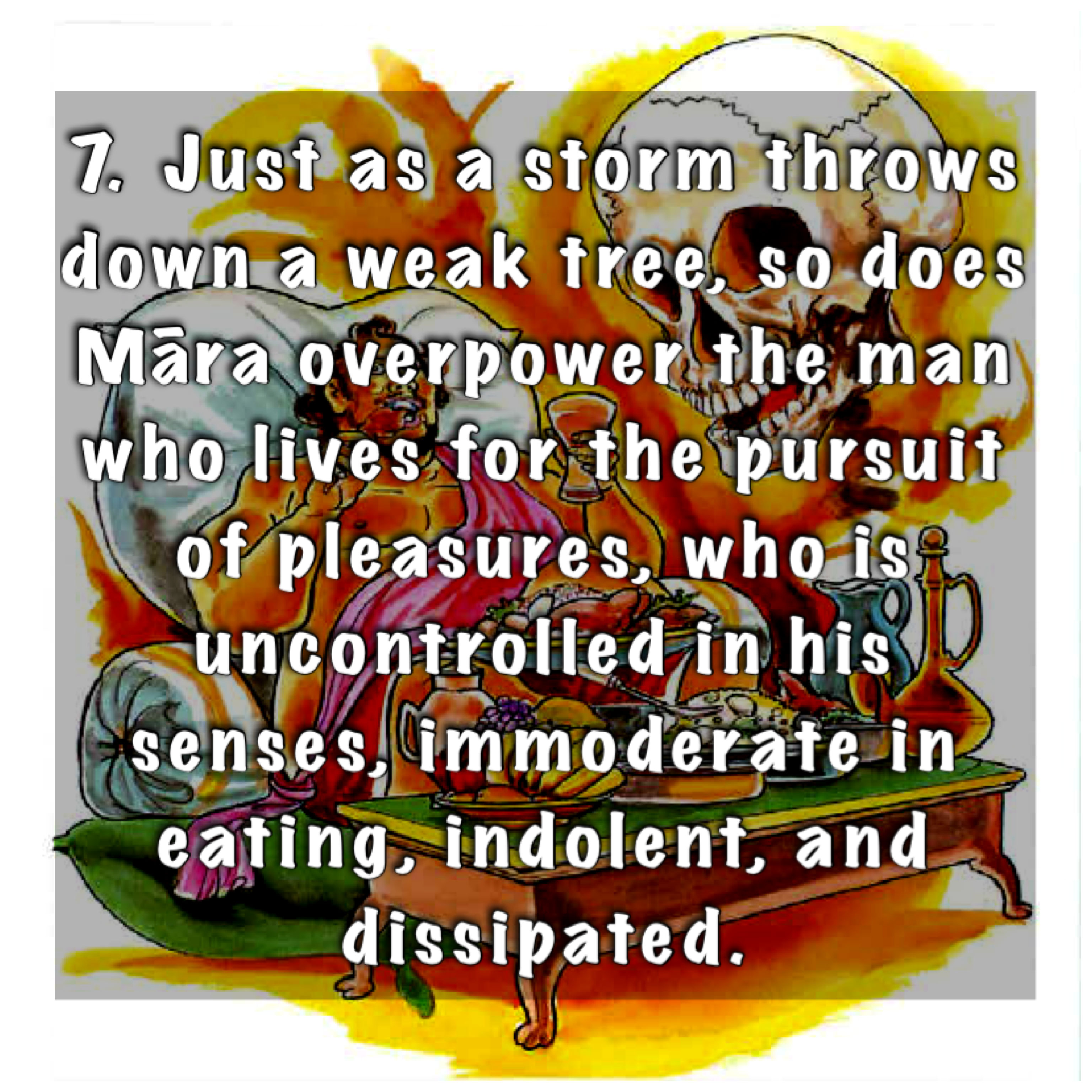
7. Just as a storm throws down a weak tree, so does Mara overpower the man who lives for the pursuit of pleasures, who is uncontrolled in his senses, immoderate in eating, indolent, and dissipated.
Please find the audio recording of this verse below. Please take the time to recite the following three times before reading the words of Lord Buddha:
Namo Tassa Bhagavato Arahato Sammā Sambudhassa (3 times).
Homage to the blessed One, the Perfected One, the Fully Awakened One (3 times).
Be sure to repeat the verse, with the verse number at least ten times out loud. It helps if you can do this multiple times a day and use as many different techniques (writing, repetition, listening) as possible.
One who beauty contemplates, whose faculties are unrestrained, in food no moderation knows, is languid, who is indolent: that one does Mara overthrow as wind a tree of little strength.
Explanation: Those who dwell on the attractiveness of sensual enjoyment, and live with the senses unguarded, and are immoderate in eating, they are slothful and weak in perseverance and will-power. Emotions overpower such persons easily as the wind overpowers a weak tree.
Be sure to repeat the verse, with the verse number at least ten times out loud. It helps if you can do this multiple times a day and use as many different techniques (writing, repetition, listening) as possible.
Still others do not understand that we must perish in this world, those who understand this, there quarrels are allayed.
Explanation: Most of us are not prepared to face the reality of impermanence and death. It is because we forget this fact that our lives are transitory, that we quarrel with each other, as if we are going to live for ever. But, if we face the fact of death, our quarrels will come to an end. We will then realize the folly of fighting when we ourselves are doomed to die. Excited by emotions our thoughts being clouded, we cannot see the truth about life. When we see the truth, however, our thoughts become free of emotions.