
“Learn this from the waters: in mountain clefts and chasms, loud gush the streamlets, but great rivers flow silently.” – Sutta Nipāta 3.725
I am almost certainly a streamlet, regardless of whether I open my mouth or not.
“Learn this from the waters: in mountain clefts and chasms, loud gush the streamlets, but great rivers flow silently.” – Sutta Nipāta 3.725
I am almost certainly a streamlet, regardless of whether I open my mouth or not.
Posted in Buddha, Buddha Vacana, Buddhism, Dhamma, Theravada | Tags: Idle Chatter, sutta nipata, Waters
Now that have officially relented and have told my wife that she can go ahead and proceed with finding a mediator to get the divorce she so badly wants, I find myself wondering how a Dhammic marriage might look.
Of course, there is the Sigalovada Sutta which provides ample guidance but I was looking for something more. I was lucky enough to stumble across Venerable Dhammika’s post on the subject, quoting the words of the Buddha as follows:
He said that a couple who are following the Dhamma will “speak loving words to each other” (aññamañña piyaṃvādā) [9] and that “to cherish one’s children and spouse is the greatest blessing” (puttadārassa saṅgaho … etaṃ maṅgalamuttamaṃ) [10] . He said that “a good wife is the supreme soulmate” (bharyā va paramā sakhā) [11] and the Jātaka comments that a husband and wife should live “with joyful minds, of one heart and in harmony” (pamodamānā ekacittā samaggavāsaṃ) [12]
Clearly, ours has not been a Dhammic union but I will do ask that is in my power to ensure that, in my thoughts, words and deeds, it becomes so in divorce.
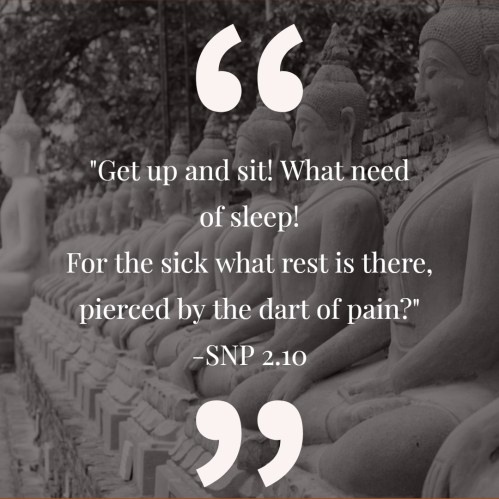
I spent last night in the ER with my son who has the flu. He scared us pretty badly but (luckily) the most serious symptom he had was dehydration. Fortunately an IV drip and 4 hours in a hospital bed resolved that.
Naturally, my routine has been upended but I got the message: life is short and can end at any time for any number of reasons. May we practice with ardor until we are no longer sick.
Posted in Buddha, Buddha Vacana, Buddhism, Dhamma, Theravada | Tags: ER, sickness, striving, Sutta Nipatta

I’ve been increasingly aware of dukkha in my home life and went searching for some quick, digestible quotes. As is usually the case with the Buddhadhamma, good sound bytes are hard to find outside of the Dhammapada (the Stoics have us there). Searching, I came across an article by the Venerable Thanissaro Bhikkhu wherein he describes the many misunderstandings of dukkha.

He identified the locks of the problems in the shift from viewing the Four Noble Truths as the basis for understanding our suffering and how to be free from it to the three characteristics of existence (tilakhana). We see most Western teachers subscribe to this misunderstanding and virtually all Mahayanists as well due to their preoccupation with emptiness (suññata/shunyata) as the prescription for ending suffering. In the quote below the Venerable is critiquing the idea that we simply need to learn to passively accept impermanence in order to free ourselves from suffering:
“Even if we’re adept at moving from one changing thing to another, it simply means that we’re serial clingers, taking little bites out of every passing thing. We still suffer in the incessant drive to keep finding the next bite to eat.”
First Things First
Clearly, this is cold comfort for those of us who are aiming for the remainderless bliss of Nibbāna.
Posted in Anatta, Anicca, Buddha, Buddhism, Dhamma, Dukkha, Theravada | Tags: Four Noble Truths, Thanissaro Bhikkhu
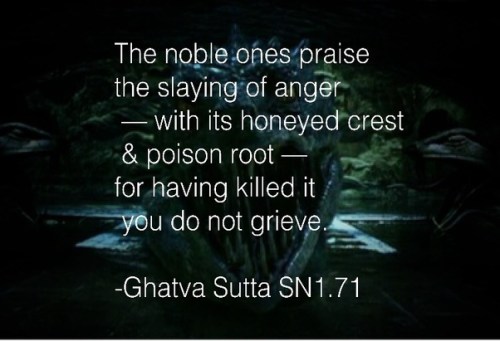
I have to take the opportunity that I have, from the time my wife awakes until she goes to bed, to learn how to overcome my own anger and resentment. Why is it that we take offence and impale ourselves on another’s words when there’s no reason to do so?
As she was standing to one side, a devatā recited this verse to the Blessed One:
“Having killed what
do you sleep in ease?
Having killed what
do you not grieve?
Of the slaying
of what one thing
does Gotama approve?”
The Buddha:
“Having killed anger
you sleep in ease.
Having killed anger
you do not grieve.
The Noble One’s praise
the slaying of anger
—with its honeyed crest
& poison root—
for having killed it
you do not grieve.”
Posted in Buddha, Buddha Vacana, Buddhism, Dhamma, Theravada | Tags: anger, Chetva Sutta, samyutta nikaya, slaying
“There are, young householder, these six evil consequences in being addicted to idleness:
“He does no work, saying:
(i) that it is extremely cold,
(ii) that it is extremely hot,
(iii) that it is too late in the evening,
(iv) that it is too early in the morning,
(v) that he is extremely hungry,
(vi) that he is too full.
“Living in this way, he leaves many duties undone, new wealth he does not get, and wealth he has acquired dwindles away.”
–Sigalovada Sutta DN31
For the first time in a few weeks, I made the first determination to wake up at my normal time of 3:50 to 4am. I had been toying with the idea of letting myself “rest” on weekend days but I have become increasingly dissatisfied with the results. Given the precious little time I have to dedicate to Dhamma and martial arts practice, it’s become apparent that I can’t really afford to sacrifice this weekend time.
But, what about sleep you ask? Although it is true that I have been using the weekend mornings to “catch up” on sleep I figure I can just as easily sneak in a nap here or there. And if I can’t, so be it. Life is short and the Buddhist and Stoic position of that we should eschew short term pleasures for long term goals. And, that, is precisely the choice I’m making.
Posted in Buddha, Buddha Vacana, Buddhism, Dhamma, Stoicism, Theravada | Tags: idleness, sigalovada sutta

We all must die and surely we will sooner than we would like. Why then are we so concerned with winning arguments? Why do we want to get someone back? So, we’re insulted? Why do we want to grab hold of the sinking excrement thrown our way and doing it back at another? Why don’t we see that we only cover ourselves in the same, fetid mess as the one who offended us?
Posted in Buddha, Buddha Vacana, Buddhism, Dhamma, Maranasati, Theravada | Tags: death, Dhammapada, quarrels

If there were one lesson that I could say had thus far characterized this life it is patience. By nature, I am an anxious and impatient person and it has taken me a full four decades to begin to understand the lessons of patience in the light of anicca, dukkha and anatta.

I work. I save. I buy. And yet happiness eludes me. Sex. Money. Homes. All of the things we think we should want and which cause us to covet, crave and kill.
May we practice well to possiate the ground for the blooming of wisdom.
Posted in Buddha, Buddha Vacana, Buddhism, Dhamma, Dukkha, Taṇhā, Theravada | Tags: Dhammapada, sensual pleasures
359 “Time flies by, the nights swiftly pass; The stages of life successively desert us. Seeing clearly this danger in death, One should do deeds of merit that bring happiness.”
360 “Time flies by, the nights swiftly pass; The stages of life successively desert us. Seeing clearly this danger in death, A seeker of peace should drop the world’s bait.”
Samyutta Nikaya
Posted in Dhamma


Improving Lives through Generosity
A hub for the music, culture, knowledge, and practice of Irish stick-fighting, past and present.
 Cattāri Brahmavihārā