Posted by: Michael | 02/16/2021

Memorization: Dhammapada Verse 3

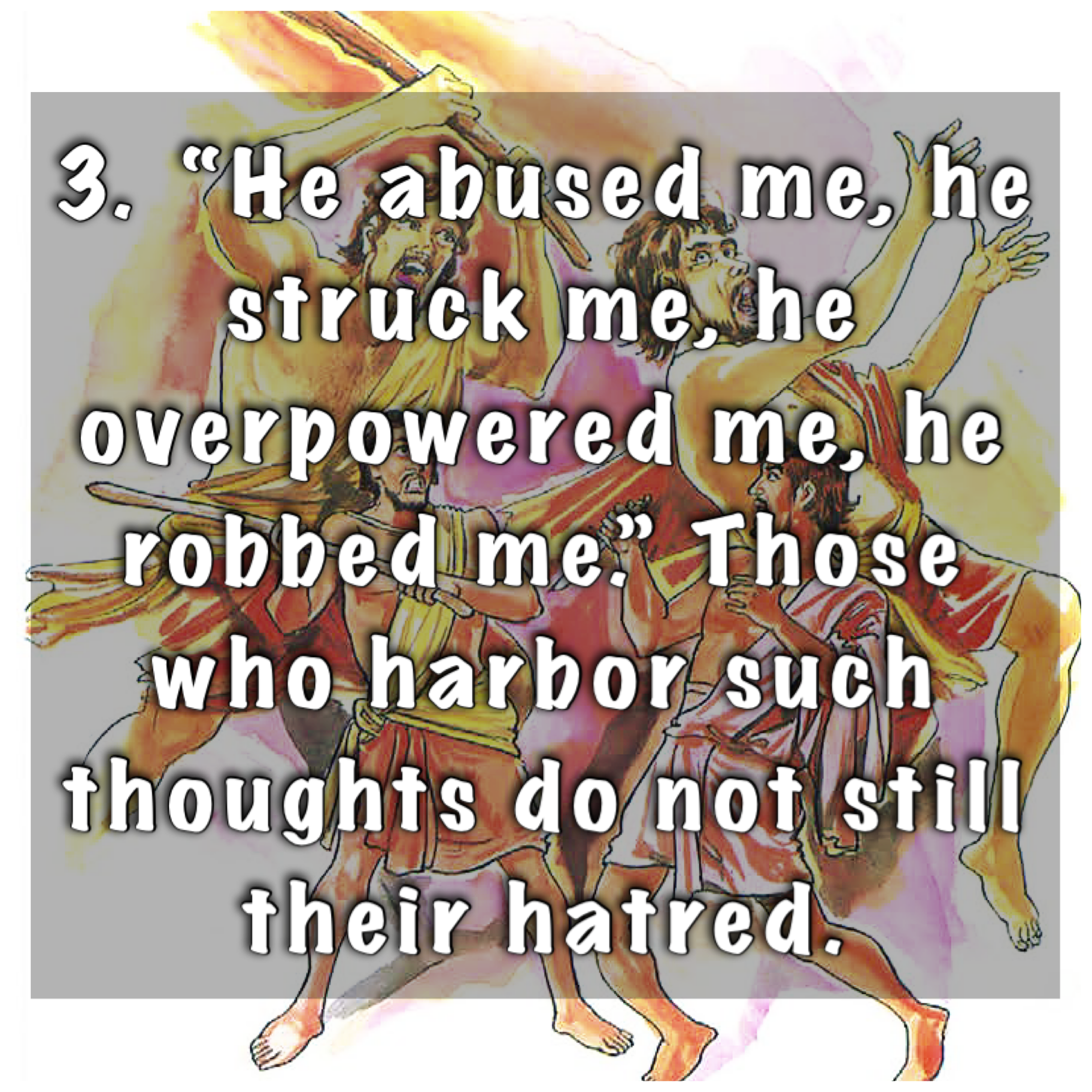
3. ” He abused, he struck me, he overpowered ne, he robbed me.” Those who harbor such thoughts do not still their hatred.

Please find the audio recording of this verse below. Please take the time to recite the following three times before reading the words of Lord Buddha:

Namo Tassa Bhagavato Arahato Sammā Sambudhassa (3 times).

Homage to the blessed One, the Perfected One, the Fully Awakened One (3 times).

https://drive.google.com/file/d/17bhXFTrCv0lZT9bz8gRrHFs-MaUU4zFb/view?usp=drivesdk

Be sure to repeat the verse, with the verse number at least ten times out loud. It helps if you can do this multiple times a day. As we progress we will eventually be trying to keep previous verses in mind as well so try to make a solid start.

The Illustrated Dhammapada, Treasury of Truth, gives the following context and explanation for the opening verse of the Dhammapada:

Verse 3. Uncontrolled Hatred Leads to Harm

Explanation: When a person holds that he was insulted, assaulted, defeated, or robbed, his anger continues to increase. The anger such a person has no way of subsiding. The more he goes over his imaginary trouble the greater becomes his desire to avenge it.

Memorize By Heart app: https://memorizebyheart.app/
Posted by: Michael | 02/16/2021

Memorization: Dhammapada Verse 2

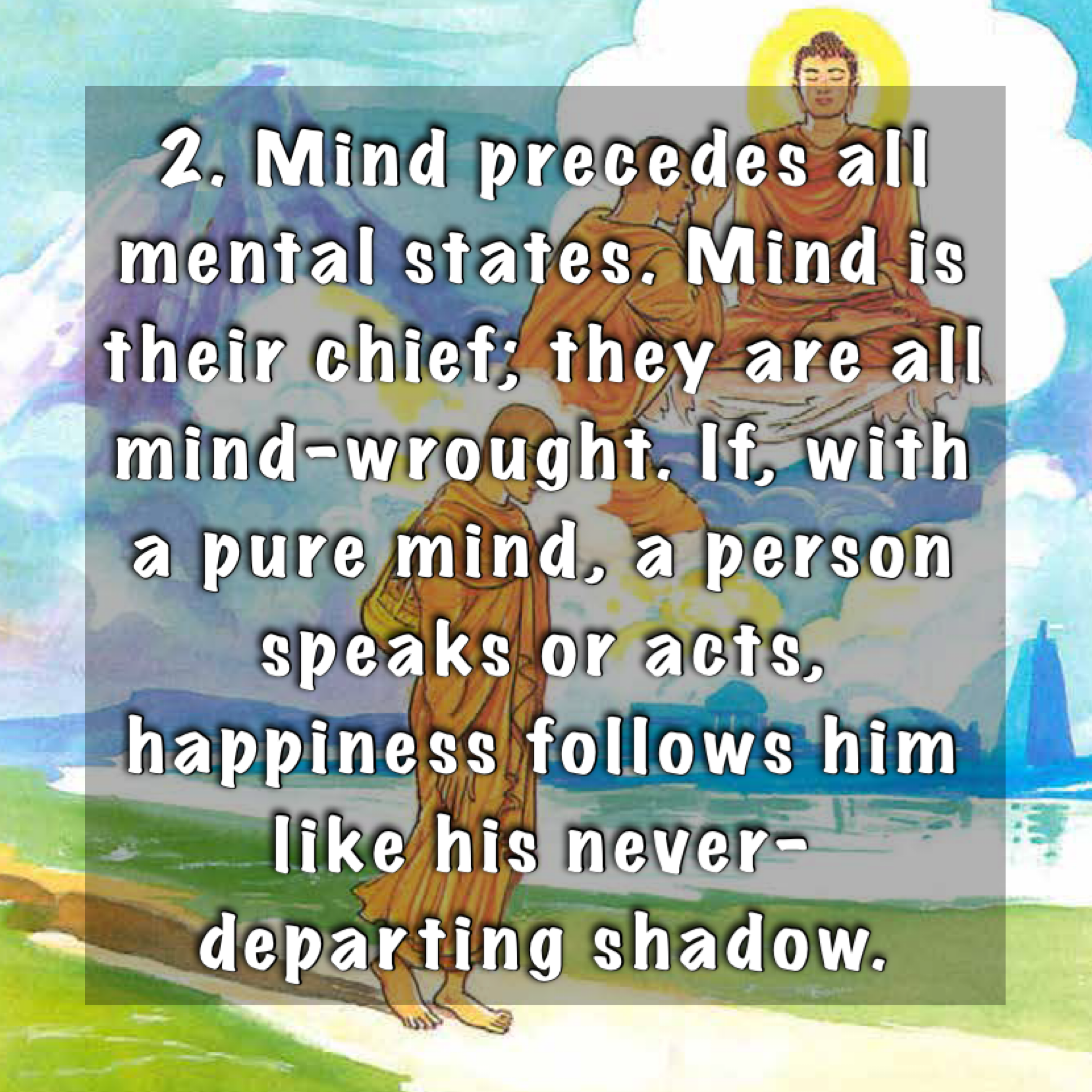
2. Mind precedes all mental states. Mind is their chief; they are all mind-wrought. If, with a pure mind, one speaks or acts, happiness follows him like his never-departing shadow.

Please find the audio recording of this verse here. I have included the Namo tassa as it is customary to recite this homage before reading the words of Lord Buddha.

https://drive.google.com/open?id=1idBCEgZpeFzOUCai_fYcQsGLg60ITxql

Be sure to repeat the verse, with the verse number at least ten times out loud. It helps if you can do this multiple times a day. As we progress we will eventually be trying to keep previous verses in mind as well so try to make a solid start.

The Illustrated Dhammapada, Treasury of Truth, gives the following context and explanation for the opening verse of the Dhammapada:

Explanation: All that man experiences springs out of his thoughts. If his thoughts are good, the words and the deeds will also be good. The result of good thoughts , words and deeds will be happiness. This happiness will never leave the person whose thoughts are good. Happiness will always follow him like his shadow that never leaves him.

I have also been using the Memorize By Heart app in conjunction with playing the audio file throughout the day to memorize the verse. Please find it here: https://memorizebyheart.app/

I have included my recitation of the first and second verses here as well. I intend to recite all of the verses learned to date and will provide it at the end of each post: https://drive.google.com/open?id=1WsNGIUQ0MaS2muBhrmZ0JUWWYstHV-DO

Posted by: Michael | 02/15/2021

Memorization: Dhammapada Verse 1

 Namo tassa bhagavato arahato sammāsambuddhassa

 Namo tassa bhagavato arahato sammāsambuddhassa

 Namo tassa bhagavato arahato sammāsambuddhassa

1. Mind precedes all mental states. Mind is their chief, they are all mind-wrought. If with an impure mind a person speaks or acts, suffering follows him like the wheel that follows the foot of the ox.

Dhammapada translated by the Venerable Acharya Buddharakkhita

Please find the audio recording of this verse here. I have included the Namo tassa as it is customary to recite this homage before reading the words of Lord Buddha.

https://drive.google.com/open?id=1idBCEgZpeFzOUCai_fYcQsGLg60ITxql

Be sure to repeat the verse, with the verse number at least ten times out loud. It helps if you can do this multiple times a day. As we progress we will eventually be trying to keep previous verses in mind as well so try to make a solid start.

The Illustrated Dhammapada, Treasury of Truth, gives the following context and explanation for the opening verse of the Dhammapada:

Explanation: All that we experience begins with thought. Our words and deeds spring from thought. If we speak or act with evil thoughts, unpleasant circumstances and experiences inevitably result. Wherever we go, we create bad circumstances because we carry bad thoughts. This is very much like the wheel of a cart following the hoofs of the ox yoked to the cart. The cart-wheel, along with the heavy load of the cart, keeps following the draught oxen. The animal is bound to this heavy load and cannot leave it.

http://www.buddhanet.net/dhammapada/d_twin.htm

I am facilitating a Dhammapada memorization group on Facebook and decided to use this blog as my sandbox and also as a repository for the finished products. May it be useful to someone.

Posted by: Michael | 02/10/2021

What’s the alternative?

Sitting in the lobby of NYU Tisch while my four year old undergoes an endoscopy. My wife was crying all morning from worry while I was doing my best to keep a level head and show good cheer for my kids.

My question is this: why does it seem that the culture at large tells us it’s wrong to soldier on, to show strength and project confidence and good cheer? Just because we do these things don’t mean that we cannot also feel fear, anxiety and worry. In fact, what good would such qualities as courage and bravery be if they didn’t arise in the midst of and as counterbalances to dread and fear?

I feel that the facile misunderstanding of a stoic countenance and demeanor has done a lot of damage to those of us concerned with authenticity. I recall, during adolescence, being preoccupied with such things and coming to the conclusion that dissembling was wrong. But, was it?

What is the alternative? If being authentic means falling to pieces, smoking, drinking or otherwise trying to escape the situation maybe authenticity should be our primary concern. Yes, it’s important to know one’s true feelings so that one can act in the most skillful way possible but to allow oneself to be overcome by negative emotions helps no one.

Hopefully I’m getting this all wrong and I’m the one who has misunderstood. However, I can’t shake the feeling that I’ve hit upon something. I know that my wife accuses me of being a sociopath because I don’t break down during times of crisis and that there is a general quasi feminist critique of so-called chauvinistic stoicism but I don’t really see the benefit of the alternative. If and when I feel the need to open up to a friend about my feelings I feel no shame in doing so but, from experience, I find that this only amplifies the negative emotions.

Still, I’m open to being completely wrong.

Posted by: Michael | 02/09/2021

Courage and Fear

I find myself facing the unpleasant feeling tone that accompanied fear. The fear of separation that naturally accompanies selfish love and attachment. My little one has to get an endoscopy tomorrow and, despite all of the assurances that these things are safe, I am still afraid that something will happen to her. But, rather than try to run from this discomfort or allow myself to get completely wrapped up and stuck in a web of anxious thoughts, I am trying to stay with the physical feelings. This, while adverting to the possibilities that, yes, she could die, during the procedure or tonight for that matter.

Why have I arbitrarily chosen to focus on the hour or so that she is under tomorrow when her death could come at any time for almost any reason? As a seeker of truth and a disciple of Lord Buddha, it is my duty to courageously face this suffering and understand it so that I can put an end to it. What better tribute and what better gift can I give to my children than the gift of Dhamma? May I practice courage today and everyday so that I can learn to look dukkha in the face and unbind the knots that keep me tied to this wheel of becoming.

Posted by: Michael | 02/05/2021

Discipline and Self Mastery

Today’s verse for memorization is Dhammapada 25 and it speaks directly to my own recent preoccupation with discipline, effort and self-mastery. given that it is in the Appamadavagga, it’s no surprise that it also concerns itself with heedfulness which is a quality that is the sine qua non of the others already mentioned.

By effort and heedfulness,

Discipline and self-mastery,

Let the wise one make for himself an island

Which no flood can overwhelm.

Dhammapada 25

This exhortation seems almost commonsensical to me but is it? Many people, therapists and healers recommend a somatic approach to overcoming trauma (a severe manifestation of dukkha) which immediately seems to discount or sideline what appears to be a largely discursive approach in Dhp 25. But is it?

The more in think about it, the less I believe that any of the Dhamma-vinaya is solely a form of ancient cognitive behavioral therapy. Rather, we are asked to find liberation in this fathom long body, not outside of it and certainly not in the rarefied world of intellectual abstraction.

It now seems to me that the tension I imagined between the Dhamma and therapeutic approaches like the one outlined in Waking the Tiger: Healing Trauma by Peter Levine was a misunderstanding on my part. In fact, if you look at the teachings of Satipatthana and Anapanasati given by teachers like Ajahn Lee, it almost seems as if they are recommending the same practices.

May we use all skillful means available to overcome dukkha and free ourselves from the chains of bondage.

Posted by: Michael | 02/03/2021

Complaints

For some time now I have been watching my mouth and my thoughts to ensure that I don’t let slip any lamentations or complaints. I’m not always successful but I feel that I have dramatically improved the quality of my speech. However, I have been noticing a funny thing has begun to occur: I am silently judging others for their inability to restrain themselves from complaint.

Even though it must be said that talking to Facebook to lament the weather, one’s day or anything else is not a productive use of one’s time, it is surely the case that passing judgement on anyone who does so is even worse. And, what is this criticism but a complaint about someone else’s behavior anyway?

If I truly want to live by a code that eschews complaint in favor of action and appreciation, I need to start to catching the mind as it moves towards criticism. Besides, none of these other people have ever made the determination to give up complaint so it’s silly to even judge them by such standards.

Posted by: Michael | 01/29/2021

Gāthā for a Difficult One

These verses came to me as I was running in the frigid dark this morning. Polyvalent thoughts, akin to the semantically nebulous forms of dreams, conveyed the meaning much better than I have been able to captured in words but I hope, at least, that these are somewhat useful.

May I learn from your weaknesses and be grateful for your virtues.

May your virtues carry you to liberation and all of the your weaknesses be overcome.

Posted by: Michael | 01/27/2021

Aspiring Hero

It is rarely easy living with others. Whether they are family, friends, colleagues or random strangers, it can be exceedingly difficult to face disdain and contempt without succumbing to it ourselves.

Call it luck or just my kamma, but I’m back in the situation that I have been for years with a wife who’s so full of resentment and disdain that it is painful and pitiable to see. But, I’m not here to talk about that or disparage her. I’m get to write about my aspiration to meet hatred with love, cruelty with kindness an, thanks to all of the difficult people in my life, I feel that I’m getting closer to it every day.

I give thanks to the people who hate and resent me l, to those who mistreat me and who test my patience; without them, I would be lost in a world of illusory comfort.

May I always learn from difficult people and those who would do me harm and may I cultivate karuna for them as a way to pay their teaching fee.

Posted by: Michael | 01/25/2021

Prepping

One of the Dhammapada verses that has been echoing continually through my mind is the following:

7. Just as a storm throws down a weak tree, so does Māra overpower the man who lives for the pursuit of pleasures, who is uncontrolled in his senses, immoderate in eating, indolent, and dissipated.

In particular, the part of the verse which speaks about being immoderate in eating leading to one’s downfall. I have practiced the uposatha pretty regularly for years and have been doing intermittent fasting for about two years now so I would like to think I’m well-versed in moderation. The truth is, however, that I’m not.

More often than I like to admit I will gorge myself after breaking fast and find it too easy to excuse myself. Still, there of something to be said for getting one’s caloric intake right during a four hour eating period. Regardless, that’s not really what I wanted to talk about.

Viewing my fasting regimen as another way to prepare for possible food shortages and learning to deal with hunger and think while hungry are yet more good reasons to stick with it. In essence, I’m fasting to bring on pain and suffering to train myself in dealing with them skillfully. Also, when food is scarce, raining will be required, so why not not familiarize oneself with it?

« Newer Posts - Older Posts »

Categories

Brightening Futures of Zanzibar

Improving Lives through Generosity

Shillelagh Studies

A hub for the music, culture, knowledge, and practice of Irish stick-fighting, past and present.