Posted by: Michael | 06/14/2016

Overcoming Disgust

When I think about compassion the image of the Lord Buddha bathing the sick, excrement covered monk who had been abandoned by his companions comes to mind more than anything else.  It goes without saying that the Tathagata had perfected all of the virtues but his ability to put aside disgust and offer true, compassionate service is something which I am striving to attain.

Which brings me to my point : here, in NYC, summer is upon us which means the thousands of homeless people are seeking refuge from the heat in trains and stations. In the past I have shrunk away from them fire to their foul smell and an almost instinctual fear of contagion but what if I didn’t? What if I simply made myself present to them? Some time ago I made sure that I always had a bottle of hand sanitizer with me so I could shake any hands proffered so any not just prepare a little better so I can be of help?

In other words, I think I’ll take the time to create a little help pack with necessities like bottled water, wipes and medicines so I can offer help directly without fear of putting my health in danger and truly connecting with the person. For my part , it’s all fine and good to donate cash but there is nothing quite as rewarding or thrilling as opening a connection to someone. I’ll need to do some more research but I’ll be back to this later.

Posted by: Michael | 06/13/2016

Chavalata Sutta: The Firebrand

“Monks, these four types of individuals are to be found existing in the world. Which four? The one who practices neither for his/her own benefit nor for that of others. The one who practices for the benefit of others but not for his/her own. The one who practices for his/her own benefit but not for that of others. The one who practices for his/her own benefit and for that of others.

Just as a firebrand from a funeral pyre — burning at both ends, covered with excrement in the middle — is used as fuel neither in a village nor in the wilderness: I tell you that this is a simile for the individual who practices neither for his/her own benefit nor for that of others. The individual who practices for the benefit of others but not for his/her own is the higher & more refined of these two. The individual who practices for his/her own benefit but not for that of others is the highest & most refined of these three. The individual who practices for his/her own benefit and for that of others is, of these four, the foremost, the chief, the most outstanding, the highest, & supreme. Just as from a cow comes milk; from milk, curds; from curds, butter; from butter, ghee; from ghee, the skimmings of ghee; and of these, the skimmings of ghee are reckoned the foremost — in the same way, of these four, the individual who practices for his/her own benefit and for that of others is the foremost, the chief, the most outstanding, the highest, & supreme.

“These are the four types of individuals to be found existing in the world.”

— translated from the Pali by Thanissaro Bhikkhu

Posted by: Michael | 06/12/2016

Namo Buddhaya

I am actually in a state of awe right now having just finished my formal morning meditation. I have taken up the practice of reciting the mantra (parikamma) Namo Buddhaya every day for fifteen minutes in the hopes of hitting 100K recitations in 3 months’ time.

Normally when reciting the mantra, I visualize Lord Buddha under the Bodhi tree but this time it ocurred to me to reflect on the various episodes from his life as recounted in the Pali Canon. I recited and reflected the courage and determination it took leave Yasodhara and Rahula sleeping n their bed, on his practicing with the Five Ascetics as the bodhisatta Later, I imagined him expounding the Dhammacakkapavattana Sutta and opening Koṇḍañña’s eyes to the Dhamma as well as some other scenes.

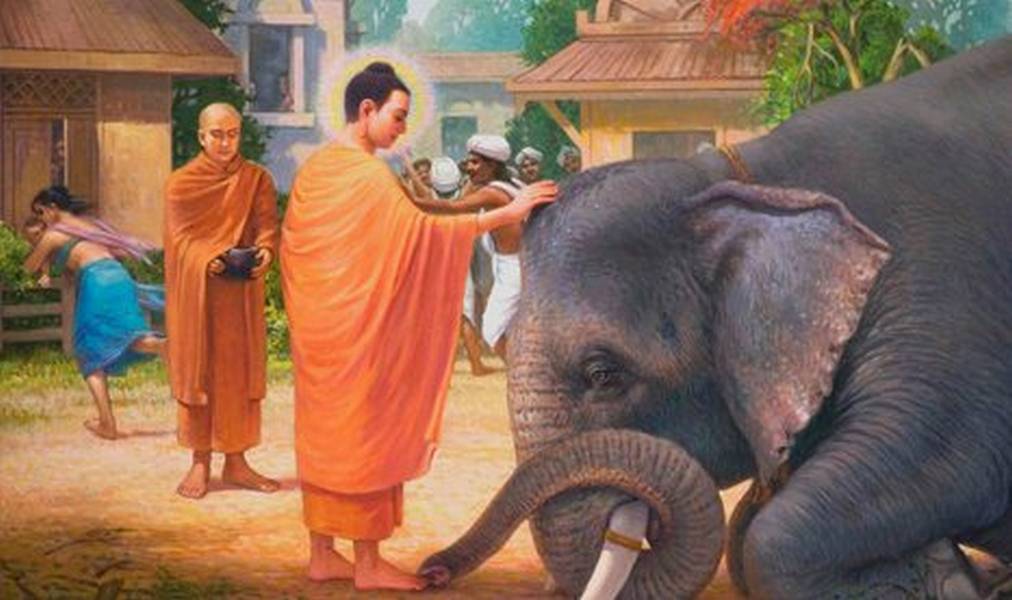
But, as my attention turned to the episode where Lord Buddha tamed the wild and intoxicated tusker Nalagiri I experienced something I have only felt once or twice in my life. As I imagined Lord Buddha gently brushing Ananda aside to prevent him from being trampled by the drunk and enraged elephant and then subduing it through the power of metta all of my hairs stood on end and my eyes began to water. Even now I still feel like crying as I’m overcome by devotion, love, gratitude and the bitter-sweet realization that I will never get to see Lord Buddha with my own eyes.

Clearly, the words completely fail to carry the meaning but, for the first time, I understand what true faith and devotion might mean. Namo Buddhaya!


Posted by: Michael | 06/10/2016

Equalizing Self and Other

If your mother became crazed and attacked you with a knife, you would relieve her of the knife. You would not then proceed to beat her up.

A Truthful Heart

One of the preliminaries to tonglen and something which I find often repeated in the Tibetan teachings, is the practice of equalizing self and other. In other words, making explicit to oneself the fact that just as I want happiness and do not want suffering so too doors person x want happiness and not suffering. Like any other practice, it can be at times thrilling and amazing while at others it can seem like a rote repetition.

I have dallied with it in the past and have decided to make a list of everyone I can remember ever having may and working with this practice with each of them, literally crossing off their name after I have contemplated our sameness using the formula once for each bead on a 36 count wrist mala.

May I transform my heart and prepare it for samma samadhi in this and future births.

Posted by: Michael | 06/09/2016

Confusion & Doubt

As fasting enters its fourth day I find myself more confused and in doubt about certain aspects of mind-training. I find that I’m not ready to accept the way in which the Tibetan Buddhist teachers I listen to define Buddhahood or the idea that one must become a Buddha to save all beings. Looking at the Pali Canon, we can clearly see that the Lord Buddha almost decided not to declare the Dhamma because he was uncertain that there were enough beings in the world ready for it. And, n another example of his unwillingness to stick around when people were being obstinate and pig-headed was during the bhikkhus’ quarrel at Kosambi. In the end, the Lord just told them to do what ethy would but he was leaving.

And yet, there is so much experiential truth in the lojong teachings that I find invaluable. Taking the blame upon myself and exchanging myself for others is both opening my heart in unexpected ways and making me a better husband and father. By bearing with criticisms, seeing the truth in them and learning from them I have avoided unnecessary conflict and been able to defuse conflict before it arises. So, I will continue learning an put metaphysical matters to the side for now. I certainly don’t need to believe in the store-house consciousness or the bhumis to make great use of these trainings. May our practice bring u to the end of suffering fro our own good and the good of all beings.

Posted by: Michael | 06/08/2016

Ramadhan and Tonglen

The second day of fasting is always the hardest for me but this year, with a focus on the practice of tonglen, I can add rock in able to give a meaning and purpose to the fast beyond simply practicing nekkhama parami.

Throughout the day as I feel hunger pains, listlessness and nausea in firms I am able to reflect on the suffering of millions of children and adults ensuring deadly famine and drought. Then I take the opportunity to imagine taking on and away their suffering and giving them what health and peace I have. Truly, my fast ends daily at a set time but for thousands of others or may only end at death. For true Muslims, with an ardent belief in God, such reflections and practices surely aren’t necessary or event the point but for someone in-between two worlds of has made Ramadhan a truly holy month.

Posted by: Michael | 06/08/2016

Emptiness of the Magic Show

What essence, monks, could there be in a magic show? Even so, monks, whatever consciousness – be it past, future or present, in oneself or external, gross or subtle, inferior or superior, far or near – a monk sees it, ponders over it and reflects on it radically. He would find it empty, hollow, void of essence. What essence, monks, could there be in a consciousness? Form is like a mass of foam and feeling but an airy bubble. Perception is like a mirage and formations like a plantain tree. Consciousness is a magic show, a juggler’s trick entire.

— Lord Buddha ( excerpted from the Kalakarama Sutta)

Posted by: Michael | 06/06/2016

Ramadhan Kareem!

It is the first day of Ramadhan and, today as for the last 12 or so years, I am observing the fast. These thirty days an nights have become a precious practice for me and offer a way to connect with Muslims around the world, strengthen the bonds between myself and family and practice nekkhama parami. This Ramadhan I hope to put special emphasis on developing metta and karuna and will be ramping up my practice of tonglen to do so. I found the following aspiration prayer at https://www.upaya.org/dox/Tonglen.pdf and think it’s a particularly poignant way to start a month of fasting. May all beings have happiness and the causes of happiness!

Having recognized the futility of my selfishness

And the great benefit of loving others, may I bring all beings to joy.

May I send all my virtues and happiness to others through the strength of my practice, and may I receive the suffering, obstacles, and defilements of all motherly beings in all realms.

Posted by: Michael | 06/05/2016

Thank You

Today’s post is going to be short. I was planning on having out of a commitment I had made but was saved by my wife’s chastising. Due to her I kept my word. Thank you.

Posted by: Michael | 06/03/2016

In Praise of Criticism

It is not good to be praised; it is better to be criticized. When you are praised, great pride arises. When you are criticized, your own mistake is blown away.

It is not good to be praised; it is better to be criticized. It is not good to have comfort; it is better to have discomfort. If you have comfort, you exhaust the merit accumulated in times past.

« Newer Posts - Older Posts »

Categories

Brightening Futures of Zanzibar

Improving Lives through Generosity

Shillelagh Studies

A hub for the music, culture, knowledge, and practice of Irish stick-fighting, past and present.