Posted by: Michael | 10/18/2017
Rouse Yourself
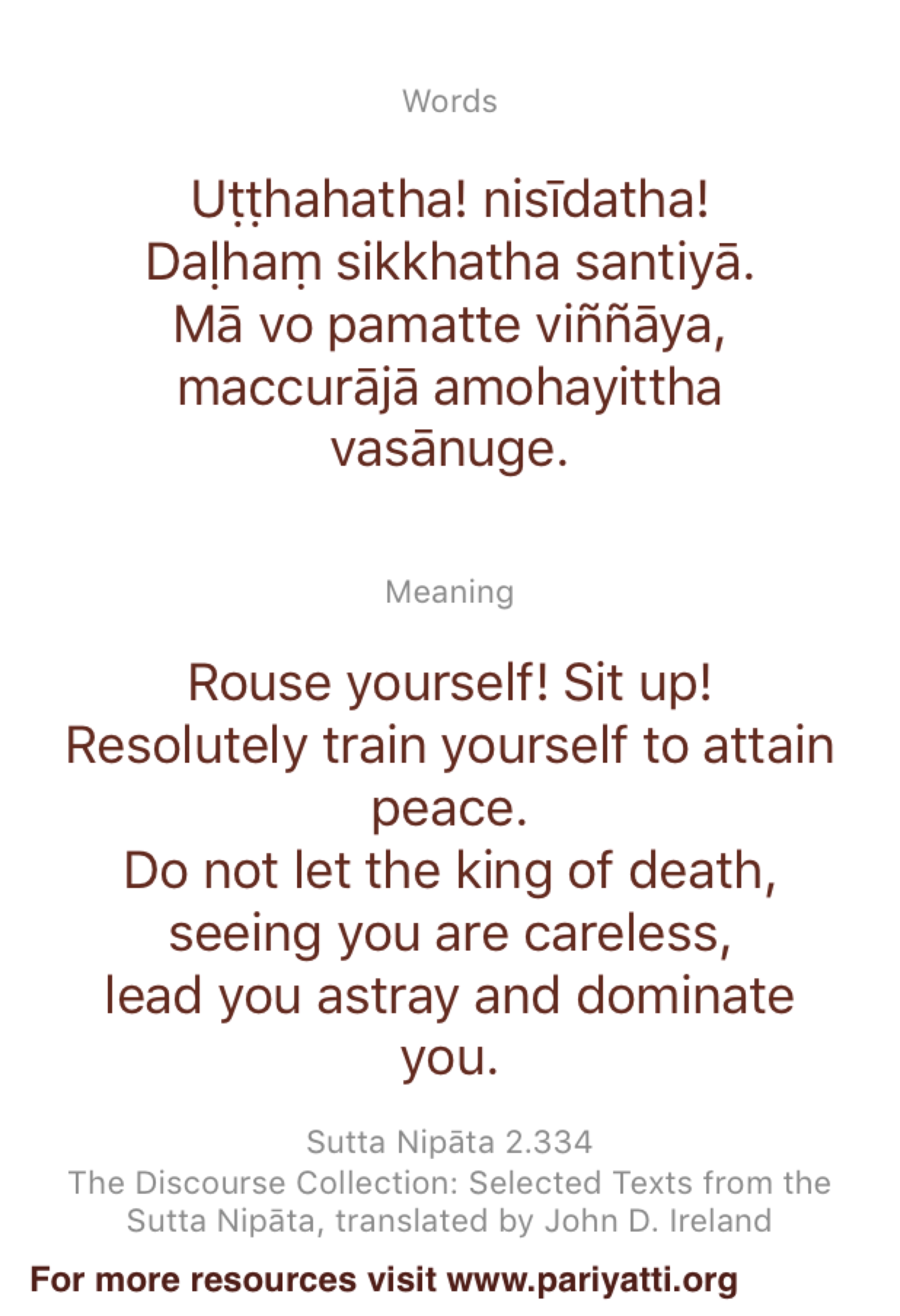
Posted in Dhamma
Posted by: Michael | 10/17/2017
Disconnected
Maybe it’s the fatigue or maybe it’s just the cyclical nature of life on a muddy sphere orbiting a presently self-contained nuclear reaction, but the familiar feeling of being disconnected has arisen one again. Then again, when I reflect this way, it seems that it may have everything to do with having broken a precept recently. Despite doing everything in my power to stone and to apply opposing powers, the kamma of it can never be erased and that may be exactly what I’m experiencing now.
Regardless of the reasons for the feeling, it’s clear that only sustained practice will get me back in the feeling of a routine. What we do really matters, both now and in the future. May I always remember that.
Posted in brahmacariya, Buddhism, Daily Practice, Dhamma, Sila, Theravada | Tags: akusala kamma, disconnection, fatigue
Posted by: Michael | 10/16/2017
Adhiṭṭhāna for Hard Times
May I make the adhiṭṭhāna now that I will forgive myself immediately for any unskillful thought, word or deed and redouble my efforts at dispatching the kilesas. May I never allow myself to fall prey to remorse and always increase my dana, sila and bhavana so that they may overwhelm the akusala kamma I have made.
Posted in Aditthana, bhavana, Buddha, Buddhism, Dana, Dhamma, Sila, Theravada | Tags: akusala kamma, generosity, meditation, morality, resolve
Posted by: Michael | 10/14/2017
The Doer of Good
Idha modati pecca modati;
katapuñño ubhayattha modati.
So modati so pamodati,
disvā kammavisuddhimattano.
Listen: http://host.pariyatti.org/dwob/dhammapada_1_16.mp3
The doer of good rejoices here and hereafter;
one rejoices in both the worlds.
One rejoices and exults,
recollecting one’s own pure deeds.
Dhammapada 1.16
Posted in Buddha, Buddha Vacana, Buddhism, Dhamma, Sila, Theravada | Tags: Dhammapada, Heaven, kamma, virtue
Posted by: Michael | 10/13/2017
No Fixing Samsara
Why rage against kings and presidents when you only defile your own mind? What of lasting good can you do when you commit violence against your own heart?
If tomorrow you could transform the world into a utopia could you then stop the explosion of the sun? Could you stop a wayward comet from plunging into the earth? Better to stop the kilesas and put an end to this round of suffering once and for all. There’s no fixing samsara.
Posted by: Michael | 10/12/2017
Guarding the Mind
It still surprises me just how easily impressions can slip in and begin replicating themselves like viral RNA until they completely overwhelm my meager defenses. In the past I have held the mistaken belief that I’m strong enough or too well practiced to succumb to random sense impressions but I have been consistently proven wrong. In fact, the minute I become aware of the thought that something won’t effect me is previously threw moment in time when the real trouble starts.
Personally, I am most easily ensnared by visual stimuli related to sexual desire for the opposite sex. I can see an ad or read soothing and find myself acting on an unskillful impulse hours later. It seems to me that the best course of action would be to recognize the danger immediately and apply the antidote as soon as possible. Far too often I have failed to do so and paid the price.
Posted in Buddha, Buddhism, Daily Practice, Dhamma, Sensual Desire, Theravada | Tags: danger, lust, replication
Posted by: Michael | 10/10/2017
Phone Troubles
Now that I’ve taken definitive steps to combat what has apparently become an addiction it’s stunning just how invasive my attachment to my phone is. I constantly find myself reaching for it and even when I’m not physically searching for it it is on my mind. It feels exactly like the relationship I had with cigarettes. Can you imagine what would happen if I were to die with this quality of mind?
Like all of the other addictions I’ve ever experienced, there is something about it that clouds my mind. In other words, any time I lose my clarity my mind starts questioning the wisdom of giving this thing up or trying to curtail its use. Why can’t I just look something up? What’s wrong with checking something on FB? What if someone texted me?
Frankly, this is going to be much harder than I initially thought but, after seeing the intensity of my attachment, I’m even more committed to forming a healthier relationship with it.
Posted in Buddha, Buddhism, Dhamma, Theravada | Tags: craving, smartphone, Technology
Posted by: Michael | 10/09/2017
Smartphone Addiction
For a so-called serious student of the Dhamma it feels almost shameful to admit how attached I am to the use of my smartphone. Whether it’s reading on the Kindle or Scribd app, listening to Dhamma talks on YouTube or commenting and chatting on Facebook, I spend an inordinate amount of time and energy on my phone. Each time it buzzes or bleeps I reach for it and, even during those stretches of silence I find myself compulsively checking it. Naturally, the quality of my awareness and attention has been slowly eroding over the years and I finally am at the point where I want to do something about it. The compulsion to check my phone feels exactly as the same as the compulsion to smoke a cigarette used to and that is simply a shackle I do not wish to take with me to the grave.
For now, I’m disabling most of the auditory and haptic notifications and intend to carry my phone in a pouch that blocks signals and radiation. I have already resolved to check Facebook only 3 times a day but now I will resolve, again, not to use my phone in transit, while walking or in the company of others. I intend to use my phone a s much as possible as a phone. Study after study has shown how these phones are making us less smart, less attentive, more isolated and more anxious. The fact that we so willingly give these things up to have instant access to a collection of facts and opinions is telling. Regardless, if my goal in this life is to make a path to the Deathless, my smartphone’s incessant dinging isn’t going to be of help. May I learn to use it as a tool and use it as such. Wish me luck!
Posted in Buddhism, Daily Practice, Dhamma | Tags: Addiction, Facebook, phones, smartphone, Technology
Posted by: Michael | 10/08/2017
Atonement
Having confessed my transgression I’m still left with how to atone for it. Initially, I’d assumed the word “atone” derived from “tone” in the sense of tuning an instrument but it has the following, equally telling etymology:
atone (v.)1590s, “be in harmony, agree, be in accordance,” from adverbial phrase atonen (c. 1300) “in accord,” literally “at one,” a contraction of at and one. It retains the older pronunciation of one. Meaning “make up (for errors or deficiencies)” is from 1660s; that of “make reparations” is from 1680s. The phrase perhaps is modeled on Latin adunare “unite,” from ad “to, at” (see ad-) + unum “one.” Related: Atoned; atoning.
So, maybe I wasn’t so far off. Anyway, the concept of seeking forgiveness and righting wrongs is always complicated without a Creator to turn to but the following piece by Ven. Chuan Guan is illuminating:
In the case of a breach of Buddhist precepts, it is not a breach against the Buddha, but against ourselves. Consequently, Buddhists in a way do not really apologise to the Buddha. Let’s take a look at Buddhist precepts to understand better.
Buddhist precepts are training rules taken up voluntarily to help us change and become better. It is like a person with high blood pressure prescribed a ‘precept’ of not taking too much salt and oil. If he take a lot of salt and oil, would the doctor be angry? Would he need to apologise to the doctor? I think the doctor would not be angry (ok, some may!), but may feel sorry for the patient, for the patient is the one who is being harmed, and not the doctor. Out of compassion, the doctor may rebuke him and suggest for ways that the patient may adopt a healthier diet, but in the end, it is still up to the patient to adopt the diet, and to follow through with it.
So when Buddhist did something against the precepts, they are really doing something against themselves and others (where their actions also harm others), and not the Buddha. Just like the doctor in the above analogy, the Buddha do not get angry with people for doing wrong things. Instead, He feels compassion for us, for He sees clearly the harm that we do to ourselves and others by breaching the precepts.
Hence ‘atonement’ is not so much an apology or seeking reconciliation from the Buddha, but ‘atonement’ refers more towards the steps we take to right the wrong.
This consist of (1) confession 忏, (2) repentance 悔 and (3) aspiration 发愿. (Some communities may develop this further and hence be more comprehensive).In Buddhism, if we do some wrong, the first step is to (1) confess the deed, (2) recognise that our deed was (2a) harmful, was wrong, ignoble, blame-worthy, unworthy, and hence, should be (2b) abandoned, removed, eradicated etc. We should, having recognised the wrong, then (3) make a firm resolve not to repeat it. But easier said than done. So, within the Buddhist text, there are very comprehensive teachings, outlining how the human psyche ticks and what triggering factors lead to others that inclines towards harmful actions that are driven by greed, anger and delusion.
Follow-up Steps
We then (1) practise distancing from triggering factors while (2) applying reflections, contemplations and other practices that transform our perception of the triggering factors so that future contact with it do not lead to the same actions. Meanwhile, we also (3) strengthen mindfulness so that if (1) fails and we encounter the trigger before we have mastered (2), then mindfulness can kick in and prevent a repeat of our earlier actions. (4) Applying proper attention is also most useful while we distant ourselves. Why preoccupy ourselves with something that upsets us?In modern day Buddhism, repentance puja (chants) are recited as part of a devotional practice that encompasses the above steps. These may be done infront of the Buddha’s image as a reminder of our spiritual direction, towards this state of perfection, Nirvana, that is humanly possible and attained by the Buddha, the Arahants and Enlightened Bodhisattvas. Where possible, confession and repentance is also done with one’s guidance teacher who knows our habits, both good and bad, and knows our tendencies and inclinations. In this way, done methodologically, it can lighten the emotional burden of wrong, while developing the mind so that we can practise restrain and not repeat our mistakes again and again.
These steps leading to an eradication of harmful actions is the full ‘atonement’ of that wrong, a full purification of that wrong.
Good news is that while difficult, it is humanly possible.
http://buddhavacana.net/2010/10/righting-a-wrong-faith-atonement/
Finally, there is the Verse of Atonement used in Zen circles (of which I happen to be a part) and which seems more relevant than ever. I will be adding this to my morning chanting.
All harmful acts, words and thoughts, ever committed by me since of old,
On account of beginningless greed, anger and ignorance,
Born of my body, speech and mind,
I now atone for them all.
May I overcome greed, hatred and delusion and make a final end to suffering.
Posted by: Michael | 10/07/2017
Remorse
I recently broke one of my precepts and have been coming to terms with that as well as reaffirming that the only way out of this mess is to continue the practice and one day abandon such unskillful behavior once and for all. The talk by Ajahn Thanissaro below has proved immensely helpful in terms of framing remorse not as a strength but as a weakness. One can’t ameliorate wrong done simply because one feels bad about it. Furthermore, feeling bad doesn’t help us to give up the behavior in the future — in fact, it may only make it more likely. Wishing you all well.
Posted in Buddha, Buddhism, Dhamma, Forgiveness, Theravada | Tags: precepts, regret, remorse, Thanissaro Bhikkhu
Categories
- Abhaya-cariya
- Abyapajjo homi
- Aditthana
- Anatta
- Anicca
- Anigho homi
- asubha
- bhavana
- Bodhisattvayana
- brahmacariya
- Buddha
- Buddha Vacana
- Buddhism
- Cheerfulness
- Confession of Fault
- Daily Practice
- Dana
- Devata
- Dhamma
- Dream Yoga | Lucid Dreaming
- Dukkha
- Family Life
- Fasting
- Forgiveness
- Formal Meditation
- Gratitude
- Islam
- Karuna
- Khanti
- Kwan Se Um
- Lojong
- mahayana
- Maranasati
- Maranassati
- maranānussati
- martial arts
- Meditation Word
- Metta
- Mudita
- Nekkhama
- pañña
- Parami
- Parisa Abhaya Dana
- Practice at Work
- Pure Land
- religio romana
- Restlessness and Remorse
- samadhi
- Samma Ajivo
- samma sankappo
- Samma Sāti
- samma vayamo
- Sammā Vācā
- Sangha
- Sensual Desire
- Seon
- Sila
- Stoicism
- Taṇhā
- Theravada
- Tibetan Buddhism
- Tisarana
- Upekkha
- Upekkha
- Uposatha
- Video
- Vipassana
- Zen


 Cattāri Brahmavihārā