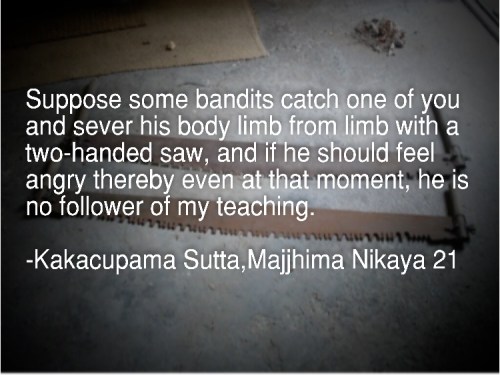
Looking for teachings on stilling anger this morning and I came across this gem again. Whenever there’s any doubt about just how serious Lord Buddha was about eradicating anger I need only recall this verse.
Looking for teachings on stilling anger this morning and I came across this gem again. Whenever there’s any doubt about just how serious Lord Buddha was about eradicating anger I need only recall this verse.
Posted in Buddha, Buddha Vacana, Buddhism, Dhamma, Metta, Theravada | Tags: anger, majjhima nikaya, simile of the saw

Posted in Buddha, Buddha Vacana, Buddhism, Dhamma, Metta, Theravada | Tags: fetters, itivuttaka, loving-kindness

227. O Atula! Indeed, this is an ancient practice, not one only of today: they blame those who remain silent, they blame those who speak much, they blame those who speak in moderation. There is none in the world who is not blamed.
This being the case it seems that the best we can do is to cultivate an inner refuge. I am still in the habit of looking to others for approval and praise which means I’m yet a prisoner to their blame. But, knowing that blame comes irrespective of our attempts to avoid it does help to put it in context.
Posted in Buddha, Buddha Vacana, Buddhism, Dhamma, Theravada | Tags: Blame, inner refuge, suffering
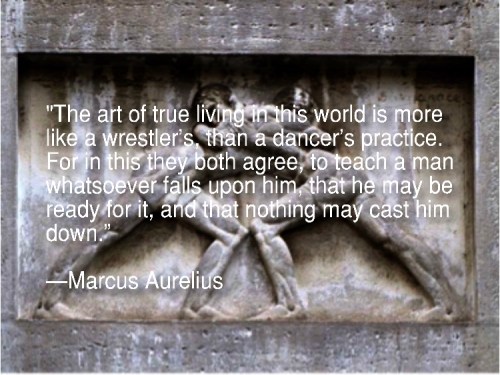 “The art of true living in this world is more like a wrestler’s, than a dancer’s practice. For in this they both agree, to teach a man whatsoever falls upon him, that he may be ready for it, and that nothing may cast him down.”
—MARCUS AURELIUS
I keep looking for the sutta where Lord Buddha exhorts is to accept short term pain for long term gain but can’t find it. Nonetheless, it definitely seems to this putthujana that the unenlightened life is more akin to a constant struggle against the kilesas than it is a dervish dance. And yet, the bliss of blamelessness or Anavajjasukha is the highest happiness of the lay life and we would do well to recall that.
Posted in Buddha, Buddha Vacana, Buddhism, Dhamma, Stoicism, Theravada | Tags: Anavajjasukha, blameless, Marcus Aurelius

Working only with one perception, in this case the perception of death, leads me sometimes to be lopsided in my thinking. I have to recall that life is also to be lived, even under the long and ever present shadow of sickness and death. And, as Marcus Aurora reminds us, it is to be lived nobly and in the light of the Dhamma.
So, precisely due to the fact that this is now (I believe) the fourth weekend in a row the kids are sick with fevers and sure throats it’s time to remember not illness and death but to live well in the midst of it all with sīla, dāna and karuna. Memento vivere.
Posted in Buddha, Buddhism, Dana, Dhamma, Dukkha, Family Life, Karuna, Maranassati, Sila, Stoicism, Theravada | Tags: compassion, death, Kids, memento vivere, sickness

“If you do not contemplate death in the morning, the morning is wasted. If you do not contemplate death in the afternoon, the afternoon is wasted. If you do not contemplate death in the evening, the evening is wasted.”
-Atisha
Worried about coronavirus? The flu? Nuclear war? Climate catastrophe? A civilization killing asteroid? Good.
These and ten thousand other things could kill you today. Let us not waste our time. Let us do good and purify our minds while there is yet time.
Posted in Buddha, Buddhism, Dhamma, Maranassati, Theravada, Tibetan Buddhism | Tags: Atisha, coronavirus, death recollection
Ayam-eva ariyo aṭṭhaṅgiko maggo, seyyathīdam:
It is this noble path with eight factors, as follows:
sammādiṭṭhi
right view
sammāsaṅkappo
right thought
sammāvācā
right speech
sammākammanto
right action
sammā-ājīvo
right livelihood
sammāvāyāmo
right effort
sammāsati
right mindfulness
sammāsamādhi.
right concentration
-Dhammacakkhapavattana Sutta
Posted in Dhamma

137. He who inflicts violence on those who are unarmed, and offends those who are inoffensive, will soon come upon one of these ten states:
138-140 Sharp pain, or disaster, bodily injury, serious illness, or derangement of mind, trouble from the government, or grave charges, loss of relatives, or loss of wealth, or houses destroyed by ravaging fire; upon dissolution of the body that ignorant man is born in hell.
https://www.accesstoinsight.org/tipitaka/kn/dhp/dhp.10.budd.

I’ve stumbled upon Ajahn Jayasaro’s book On Love and have to admit that I’m taken with his terse and incisive analysis. The quote above struck me perhaps due to my own recent musings over the state of my marriage now and the feelings and choices that brought me to this place.
As much as I am loathe to admit it, twenty some years ago when I met my wife I really did believe that love would make everything better. I really did believe that a romantic partner was the answer to life’s suffering. How far I’ve come since then buy outs pretty clear just how dangerous such a belief and view is.
Still, seeing that we were both deeply mired in delusion at least opens a space for compassion now, even if I cannot always be so open with my wife about it these days. Anyway, the book is enlightening to read as I perform the post mortem for this marriage and I would highly recommend it to all.
Posted in Buddha, Buddhism, Dhamma, Family Life, Taṇhā, Theravada | Tags: Ajahn Jayasaro, love, marriage
Namo Tassa Bhagavato Arahato Samma Sambuddhassa !
Homage to the Blessed One, the Worthy One, the Supremely Enlightened One !On one occasion the Blessed One was dwelling at Savatthi, in Jeta’s Grove. Then Queen Mallika approached the Blessed One, paid homage, and said to him:
(1) “Bhante, why is it that some women here are (i) ugly and unsightly; (ii) poor, and needy, (iii) lacking in influence?
(2) And why is it that some are (i) ugly and unsightly; but (ii) rich, with great wealth and property; (iii) and influential?
(3) And why is it that some women here are (i) beautiful, attractive, and possessing supreme beauty of complexion; (ii) but poor and needy; and (iii) lacking in influence?
(4) And why is it that some are (i) beautiful, attractive; (ii) rich, with great wealth and property; (iii) and influential?”(1) “Here, Mallika, (i) some woman is prone to anger and easily annoyed.(ii) She does not give things. (iii) And she is envious. When she passes away from that state, if she comes back to this world, wherever she is reborn (i) she is ugly, ill formed, and unsightly; (ii) poor, and needy; (iii) and lacking in influence.
(2) “Another woman is (i) prone to anger and easily annoyed (ii) But she gives things. (iii) And she is without envy. When she passes away from that state, if she comes back to this world, wherever she is reborn (i) she is ugly, ill formed, and unsightly; (ii) but she is rich, with great wealth and property; (iii) and influential.
(3) “Still another woman is (i) not prone to anger or often annoyed. (ii) But she does not give things. (iii) And she is envious. When she passes away from that state, if she comes back to this world, wherever she is reborn, (i) she is beautiful, attractive, and graceful. (ii) But she is poor, needy, with little wealth; (iii) and lacking in influence.
(4) “And still another woman is (i) not prone to anger or often annoyed. Even if she is criticized a lot, she does not lose her temper and become irritated, hostile, and stubborn; she does not display anger, hatred, and bitterness (ii) And she gives things to ascetics; food and drink; clothing and vehicles; (iii) And she is without envy, one who does not envy, resent, or jealous of the gain, honor, respect, esteem, homage, and worship given to others. When she passes away from that state, if she comes back to this world, wherever she is reborn (i) she is beautiful, attractive, and graceful, possessing supreme beauty of complexion; (ii) rich, with great wealth and property; (iii) and influential.
When this was said, Queen Mallika said to the Blessed One: “I suppose, Bhante, (i) that in some earlier life I was prone to anger and often annoyed. Therefore I am now ugly, ill formed, and unsightly. (ii) But I suppose that in some earlier life I gave things. Therefore I am now rich, with great wealth and property. (iii) And I suppose that in some earlier life I was without envy. Therefore I am now influential. In this court there are girls of Khattiya, Brahmin, and householder families over whom I exercise command.
“From today, Bhante, (i) I will not be prone to anger and often annoyed. Even when I am criticized a lot I will not lose my temper and become irritated, hostile, and stubborn; I will not display anger, hatred, and bitterness. (ii) And I will give things to ascetics or Brahmins: food and drink; clothing and vehicles; bedding, dwellings, and lighting. (iii) And I will not be envious, one who envies, resents, and jealous of the gain, honor, respect, esteem, homage, and worship given to others.“Excellent! Bhante, Excellent! Let the Blessed One consider me a lay follower who from today has gone for refuge for life.”
Sādhu ! Sādhu !! Sādhu !!! ( Excellent )
May we all reign in our anger, give to worthy ones and let go of envy.


Improving Lives through Generosity
A hub for the music, culture, knowledge, and practice of Irish stick-fighting, past and present.
 Cattāri Brahmavihārā