Posted by: Michael | 03/01/2020

To Live Nobly

My Post (20)

Men do not care how nobly they live, but only how long, although it is within the reach of every man to live nobly, but within no man’s power to live long.

Seneca (Letters from a Stoic – Letter XXII:  On the Futility of Half-way Measures)

What does it mean to live nobly? To be a hero? To do great things? To protect the weak? To fight for justice? Well, I’m sure it can mean all of those things but for me, a noble life is one dedicated to the pursuit of virtue, generosity and wisdom.

Am I living a noble life now? If such a life consists of the constant striving towards those goals rather than one’s attainment thereof, then, it is quite possible that my life is being lived as nobly as is possible at present. And, yet, there is something that’s not quite right about that assertion. Call it fear of complacency or pride, but it almost seems too much to say that my life is being lived nobly. Perhaps I’ll settle for living my life in pursuit of path of the Noble Ones (the arahants).
Posted by: Michael | 02/29/2020

Upajjhatthana Sutta – Verse on Sickness

My Post (19)

What is the advantage of often reviewing this: ‘I am liable to get sick, I am not exempt from sickness’? There are sentient beings who, drunk on the vanity of health, do bad things by way of body, speech, and mind. Reviewing this subject often, they entirely give up the vanity of health, or at least reduce it. This is the advantage of often reviewing this: ‘I am liable to get sick, I am not exempt from sickness’.

https://suttacentral.net/an5.57/en/sujato

Posted by: Michael | 02/27/2020

The Five Subjects

My Post (17)

Jarā-dhammomhi jaraṁ anatīto.

I am subject to aging. Aging is unavoidable.

Byādhi-dhammomhi byādhiṁ anatīto.

I am subject to illness. Illness is unavoidable.

Maraṇa-dhammomhi maraṇaṁ anatīto.

I am subject to death. Death is unavoidable.

Sabbehi me piyehi manāpehi nānā-bhāvo vinā-bhāvo.

I will grow different, separate from all that is dear & appealing to me.

Kammassakomhi kamma-dāyādo kamma-yoni kamma-bandhu kamma-paṭisaraṇo.

I am the owner of my actions, heir to my actions, born of my actions, related through my actions, and live dependent on my actions.

Yaṁ kammaṁ karissāmi kalyāṇaṁ vā pāpakaṁ vā tassa dāyādo bhavissāmi.

Whatever I do, for good or for evil, to that will I fall heir.

Evaṁ amhehi abhiṇhaṁ paccavekkhitabbaṁ.

We should often reflect on this.

Five Subjects for Frequent Recollection

The coronavirus is here and its spread is unavoidable. Wake up. Aging has always been here. Sickness, death and loss too. All that we take with us is our kamma. Make merit while you can. Give freely. Meditate and reflect.

Posted by: Michael | 02/25/2020

Coronavirus: The Divine Messenger

Let me respectfully remind you:

Life and Death are of supreme importance.

Time swiftly passes by and opportunity is lost.

On this night, the days of our life are decreased by one.

Each of us should strive to awaken.

Awaken! Take heed! Do not squander your life.

Zen Evening Gatha

This is what you have been practising for. This moment when sickness and death are descending upon millions of your brothers and sisters. This moment when you, too, could have just contracted the disease.

And, although the world at large seems only now to be awakening to the ineluctable fact that these bodies are all subject to aging, illness and death, this was to have been your practice all along. Wasn’t it?

How fortunate you are to have the time to realize this truth so make haste now and practice.

Practice before you fall ill.

Practice before your children, parents, wife and friends fall ill.

Practice to be of use to yourself and those with whom you love.

Practice so that you can be off use even if your life comes to be solely a teaching on how to sicken and die without fear or regret.

Posted by: Michael | 02/25/2020

Mouth Yoga

Tashi Nyima's avatarGreat Middle Way

Image result for Thich Nhat HanhWhy should I smile when there is no joy in me? The answer is that smiling is a practice.
There are over three hundred muscles in your face. When you are angry or fearful, these muscles tense up. The tension in these muscles creates a feeling of hardness. If you know how to breathe in and produce a smile, however, the tension will disappear —it is what I call “mouth yoga.”

Make smiling an exercise. Just breathe in and smile; the tension will disappear, and you will feel much better.

Thich Nhat Hanh

View original post

Posted by: Michael | 02/24/2020

Sending Thoughts Out

My Post (16)

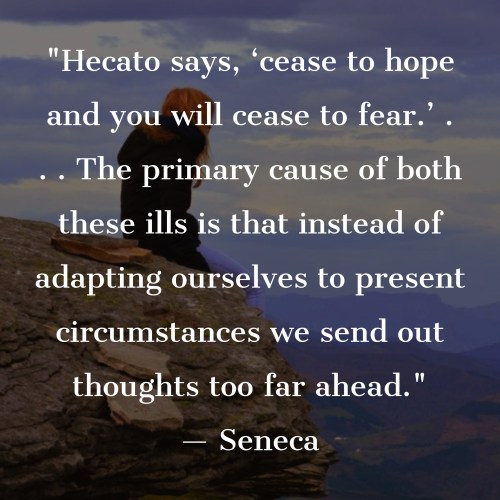
“Hecato says, ‘cease to hope and you will cease to fear.’ . . . The primary cause of both these ills is that instead of adapting ourselves to present circumstances we send out thoughts too far ahead.”

— Seneca

I don’t know why but the Seneca quote above got me thinking about all of the times I have read or heard the Thai Forest masters speak about not “sending the mind out” to harass or disturb the world. Looking for some good quotes from the ajahns I found this passage from Ajahn Lee Dhammadaro’s Keeping the Breath in Mind:

Now you can stop counting the breaths, and simply think bud- with the in-breath and dho with the out. Let the breath be relaxed and natural. Keep your mind perfectly still, focused on the breath as it comes in and out of the nostrils. When the breath goes out, don’t send the mind out after it. When the breath comes in, don’t let the mind follow it in. Let your awareness be broad, cheerful, and open. Don’t force the mind too much. Relax. Pretend that you’re breathing out in the wide open air. Keep the mind still, like a post at the edge of the sea. When the water rises, the post doesn’t rise with it; when the water ebbs, the post doesn’t sink.

Keeping the Breath in Mind

So, whether it be in meditation or daily life, may we endeavor to collect the mind and redirect it to our present task.

Posted by: Michael | 02/23/2020

Factors of the Uposatha

My Post (15)

One should not kill a being
or take what is not given;
should not tell a lie
or be a drinker of strong drink;
should abstain from uncelibacy, the sexual act;
should not eat at night, the wrong time of day;
should not wear a garland or use a scent;
should sleep on a pallet, a mat spread on the ground —
for this eight-factored Uposatha
has been proclaimed by the Awakened One
to lead to the end
of suffering & stress.

Muluposatha Sutta AN 3.70

Posted by: Michael | 02/22/2020

The Blessing of Misfortune

My Post (14)

Having a hard day? A hard week? A hard life? Take heart. Hold it well and these difficulties will remove the dross from your character. Wishing everyone well today.

Posted by: Michael | 02/21/2020

Disappointment

I’ve disappointed myself again by putting myself in a situation where I was almost sure to act ignobly and, sure enough, I did. Unsurprisingly, I spent most of the morning in remorse and I realize that, more than actually wanting to prevent the arising of such states and the commission of ignoble acts, I just don’t like the feeling of remorse.

There’s a lot of work ahead of me.

Posted by: Michael | 02/20/2020

Just as a Mother

My Post (12)

Despite the fact that the simile being used is to describe how one should guard one’s mind full of love (or so says the Venerable Thanissaro Bhikkhu), the semantic drift of one imagining oneself as a mother to all beings is still quite useful. Of all the suttas in the Canon I have to admit that the Karaniya Metta Sutta is one of my favorites.

« Newer Posts - Older Posts »

Categories

Brightening Futures of Zanzibar

Improving Lives through Generosity

Shillelagh Studies

A hub for the music, culture, knowledge, and practice of Irish stick-fighting, past and present.