Posted by: Michael | 06/06/2025

Prostrations for Requesting Forgiveness

Generated image

I have had an on-and-off prostration practice since I was first introduced to it via Korean Zen. I even completed 3000 prostrations before I took precepts with Samu Sunim. Suffice it to say that I find the practice to be powerful in a way I can’t quite explain and have continued to use it over the years.

I have been working a lot with resentment and anger, and realized that bowing and requesting forgiveness could be particularly effective. As a result, I had ChatGPT translate the verse below and incorporate it into a bowing forgiveness practice. May it be of benefit, and if not, may you leave it aside.

Pāli Forgiveness Verses for 108 Prostrations

🔹 First 27 Prostrations – Parents

“Mātāpitu me khameyyātha, kataṃ sabbaṃ accayantaṃ.”

“Mother and Father, may you forgive me for all my wrongs.”

(Optional addition):

“Mātāpitu me khamaṃ detha, sabbakālaṃ mettaṃ bhavatu.”

“Mother and Father, grant me forgiveness; may there be loving-kindness at all times.”

🔹 Second 27 Prostrations – Spouse

“Bhariyāya me khameyyāsi, kataṃ sabbaṃ aparādhaṃ.”

“My wife, may you forgive me for all the offenses I have done.”

(If female and addressing husband:

“Sāmiko me khameyyāsi…”)

🔹 Third 27 Prostrations – Children

“Putte me khameyyātha, kataṃ sabbaṃ dukkataṃ.”

“My children, may you all forgive me for all my unskillful acts.”

(If one child:

“Putto me khameyyāsi…” for son,

“Duhitā me khameyyāsi…” for daughter)

🔹 Final 27 Prostrations – All Beings I Have Hurt

“Sabbe sattā khameyyātha me, kataṃ sabbaṃ dukkataṃ.”

“May all beings forgive me for every unwholesome deed I have done.”

Alternate/additional for deeper humility:

“Anavajjaṃ me bhavatu, sabbe sattā sukhitā hontu.”

“May I be blameless, may all beings be happy.”

🕯️ Optional Closing Line (After 108 Prostrations)

“Khamatu me sabbaloko, mettacittaṃ bhavatu me.”

“May the whole world forgive me; may I abide in a heart of loving-kindness.”

Posted by: Michael | 05/30/2025

Finding the Good in Evil People

Maybe it’s just me, but I rarely ever see people dwelling on the good in others with whom they disagree. And, although this may not seem like a subject that merits further investigation, I have seen Thurber terrible consequences that this tendency to see only the bad in others brings about in my own heart and mind.

The mine rebels at the mere hint that our enemies or evil people could possibly possess any good qualities but why is that? Are they truly bad or is it possible that much of the so-called evil is a result of the relationship or web of relationships that bind us together? Even if we can’t go this far, most of us will admit that it takes two to tango and that we’re contributing in some way to the aversion and unskillfulness.

What I’ve found is that when in take the time to cultivate an appreciation of the good in others, my heart softens and, eventually, a way to forgiveness and mettā becomes possible. The relationship (whether with a fascist president or a resentful wife) becomes workable. I can forgive and live without the terrible burden of hatred, anger and bitterness.

I’ll post some suggestions for mudita meditations but what better way to begin than at the source:

As for a person who is impure in his bodily behavior & verbal behavior, but who periodically experiences mental clarity & calm, how should one subdue hatred for him?

Just as when there is a little puddle in a cow’s footprint, and a person comes along, burning with heat, covered with sweat, exhausted, trembling, & thirsty. The thought would occur to him, ‘Here is this little puddle in a cow’s footprint. If I tried to drink the water using my hand or cup, I would disturb it, stir it up, & make it unfit to drink. What if I were to get down on all fours and slurp it up like a cow, and then go on my way?’ So he would get down on all fours, slurp up the water like a cow, and then go on his way.

In the same way, when an individual is impure in his bodily behavior & verbal behavior, but periodically experiences mental clarity & calm, one should at that time pay no attention to the impurity of his bodily behavior…the impurity of his verbal behavior, and instead pay attention to the fact that he periodically experiences mental clarity & calm.

Thus the hatred for him should be subdued.

Aghatavinaya Sutta: Subduing Hatred

Posted by: Michael | 05/25/2025

In the Fray

If, in the fray, the soldier drops his sword,
In fright, he swiftly takes it up again. So likewise, if the arm of mindfulness is lost,
In fear of hell be quick to get it back.

  • Shantideva
Posted by: Michael | 05/24/2025

The Humbling

Today I took a trial class at a new BJJ school. I did a Muay Thai pads class before but felt good enough when the gi class started. All was good and most everybody was a white belt. Imagine my surprise when the live rolls started and I got my butt handed to me in most of the rolls. Humbling, and I was happy I used my white belt instead of my blue belt.

There are a few main takeaways and I’ll list them in no particular order:

  • I definitely need to train here.
  • I definitely need to keep putting myself in places and circumstances where I’m humbled and where I’m not particularly skilled.
  • Failure and defeat are particularly salutary, especially when I don’t allow myself to make excuses.

A corollary to all of the above, and which I experienced in the Muay Thai class as well as with one particular partner in BJJ, is that some guys want to take your head off and dominate you. In MT I definitely felt that I could handle myself whereas in BJJ I got owned but that doesn’t actually matter. What matters to me is that it’s an opportunity to train in remaining with a mind full of friendliness despite what the other person is putting out. Martial arts offers an opportunity to train this kind of friendliness in the most visceral, embodied way possible and is crucial for anyone seriously contemplating nonviolent resistance.

Posted by: Michael | 05/20/2025

Right Livelihood in a Time of Fascism

Right Livelihood Is an Act of Resistance

Right Livelihood—earning a living without causing harm and while upholding truth and justice—is not a passive virtue. It is an active form of resistance. In the face of injustice, exploitation, and institutionalized violence, choosing a livelihood rooted in compassion and integrity becomes an unmistakable stance against complicity.

The Front Line of Nonviolence

Nonviolent resistance doesn’t begin with mass protests. It begins in our daily decisions—what we buy, where we work, how we act in systems of power. Right Livelihood ensures that our work does not fuel the machinery of oppression. It keeps our hands clean while our hearts stay awake.

In a world where profit is often prioritized over principle, refusing to take part in harmful industries is a bold rejection of structural violence. Whether it’s saying no to designing algorithms that surveil, turning down a job that pollutes, or refusing to lie to customers for profit—these are nonviolent acts of defiance. They take courage. They matter.

The Myth of “Just Following Orders”

History has exposed the moral bankruptcy of the excuse: “I was just following orders.” From the Nuremberg trials to the modern-day whistleblower, we’ve learned that obedience is no excuse for injustice. If our work demands that we betray our values, we must stop. If our paycheck is tied to harm, we must question it.

Right Livelihood demands that we think, not just comply. It is the antidote to blind obedience. To say, “I cannot do this,” when asked to harm, is a form of civil disobedience. It is a spiritual declaration that no institution, corporation, or government has the right to command our conscience.

A Call to Courage

If nonviolence is love in action, Right Livelihood is love in labor. The work we do is not neutral—it either contributes to liberation or to suffering. Let us choose, as clearly and courageously as the great resisters of our time, to make our work part of the solution.

To resist with peace, begin at your desk, in your shop, in your field. Begin where you stand.

Posted by: Michael | 05/13/2025

Changing Your Perspective to Deal with Conflict

I wanted to share my thoughts on how we might begin to take definitive action against the cruelty being perpetrated on so many but in a way that accords with the Dhamma. I struggle on a daily basis to work out my own response and attitude to so much suffering so please take the following with a huge boulder of salt. It is, like all things, subject to change and will surely be revised through contemplation and testing.

To stand as a human shield against ICE deportations is to embody fierce compassion. We prepare not with hatred—but with meditation, to still the mind and awaken our vow to protect life. We train our bodies, not to strike, but to endure—grounded and unshaken. We study martial arts, not for violence, but for control, discipline, and the ability to remain calm when fear rises.

This is the Dhamma in action. Nonviolence is not weakness. It is love with muscle.

Be a conscientious objector. Be the barrier between cruelty and the vulnerable. Prepare your heart. Train your body. Center your mind. Stand in peace.

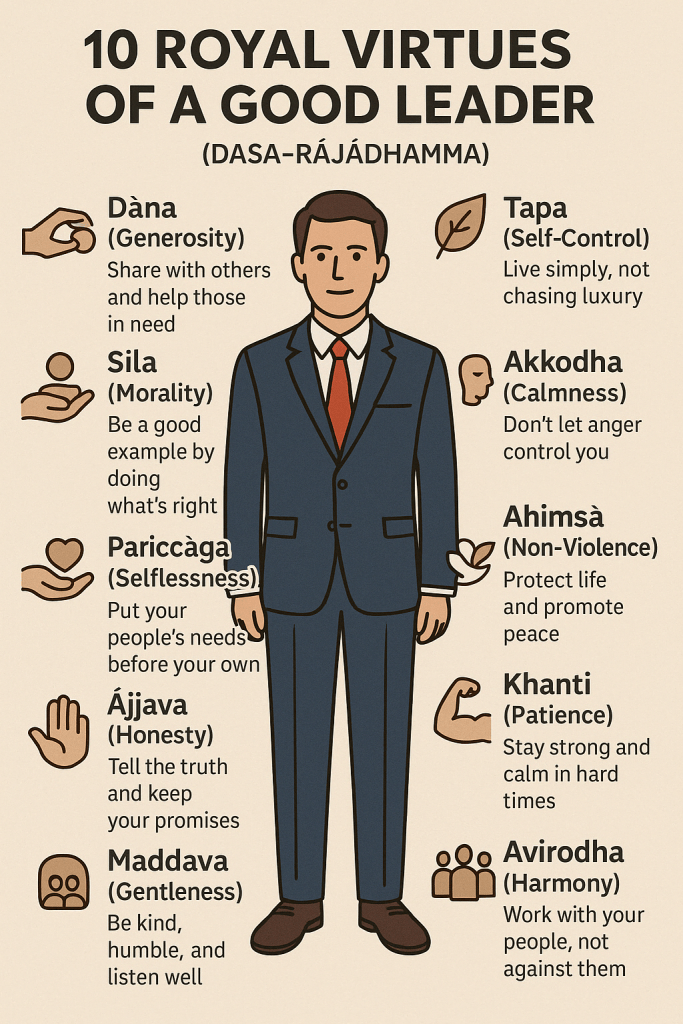
  1. Dāna (Generosity) – Share with others and help those in need.
  2. Sīla (Morality) – Be a good example by doing what’s right.
  3. Pariccāga (Selflessness) – Put your people’s needs before your own.
  4. Ājjava (Honesty) – Tell the truth and keep your promises.
  5. Maddava (Gentleness) – Be kind, humble, and listen well.
  6. Tapa (Self-Control) – Live simply, not chasing luxury.
  7. Akkodha (Calmness) – Don’t let anger control you.
  8. Ahimsā (Non-Violence) – Protect life and promote peace.
  9. Khanti (Patience) – Stay strong and calm in hard times.
  10. Avirodha (Harmony) – Work with your people, not against them.
Posted by: Michael | 04/15/2025

Aspiration for Rebirth

By the merit I have generated through this action,
May I be reborn in the presence of the Blessed One, Lord Metteyya.
May my heart be steadfast and my resolve unshakable.
May I cultivate unwavering courage and tireless energy.

Through this determination, may the Blessed One look upon me and say:
“This one shall be foremost in energy and courage.”

May this apsiration guide me through innumerable rebirths, for the welfare of all beings.

Posted by: Michael | 02/08/2025

The King of Death

We live like a chicken who doesn’t know what’s going on. In the morning it takes its baby chicks out to scratch for food. In the evening, it goes back to sleep in the coop. The next morning it goes out to look for food again. Its owner scatters rice for it to eat every day, but it doesn’t know why its owner is feeding it. The chicken and its owner are thinking in very different ways.

The owner is thinking, “How much does the chicken weigh?” The chicken, though, is engrossed in the food. When the owner picks it up to heft its weight, it thinks the owner is showing affection.

We too don’t know what’s going on: where we come from, how many more years we’ll live, where we’ll go, who will take us there. We don’t know this at all.

The King of Death is like the owner of the chicken. We don’t know when he’ll catch up with us, for we’re engrossed—engrossed in sights, sounds, smells, tastes, tactile sensations, and ideas. We have no sense that we’re growing older. We have no sense of enough.

-Ajahn Chah

« Newer Posts - Older Posts »

Categories

Brightening Futures of Zanzibar

Improving Lives through Generosity

Shillelagh Studies

A hub for the music, culture, knowledge, and practice of Irish stick-fighting, past and present.